EVALUATION OF SHAMPOO 117 there is so much less background and so much greater divergence of opinion on performance evaluations than on evaluation of physical properties. And, after all, our proclucts are purchased by the consumer chiefly for their performance and not for their physical appearance--or at least we like to think so. Recognized and valid procedures for evaluation of foaming power, detergency, curl strength--to name just a few properties important in shampoo evaluation--would go a long way toward achieving more ob- jective screening and more scientific study of raw materials and finished products. Reproducibility of a procedure is not suffident when we are dealing with performance characteristics, although it is, of course, an essential property. In the case of standardized procedures for physical properties we are setting up specifications for an inanimate object, the product itself. By the very definition of performance properties for cosmetics, we must concern our- selves with the interaction of the product and the human body. And this most decidedly introduces complications. We all know, of course, that no two human beings are identical and that the effect of a preparation on one person may be quite different on another. This is merely another way of stating that we must be sure that any performance test which is developed must be based on the use of sufficiently large groups of subjects so that the results may be considered statistically valid for the population at large. Other considerations come to mind, as well. A test procedure for per- formance evaluation must be not only reproducible but must be able to predict with at least fair accuracy the results which will be obtained under actual consumer usage conditions of the product. Whenever possible, the performance tests should be set up so as to study the interaction of the product with the portion of the body to which the product is normally applied. Thus studies of shampoos should be made using human hair studies of deodorants and antiperspirants should be made on the axillae, etc. Only when it is impossible to develop such direct measurement techniques should we consider other test procedures. It is possible, very often, to develop procedures using other than human hair or skin as the substrate but in all such cases steps must be taken to prove that data obtained in such a procedure can be correlated with results on the appropriate portion of the human anatomy. Not only must a procedure not based on actual usage conditions give the same relative order of effectiveness for a group of products as obtained under usage conditions but also the order of magni- tude of the effects should also be the same. Otherwise, erroneous inter- pretations may be drawn from such data. To summarize very briefly what I am saying, the function of a perform- ance evaluation test is to enable us to work under standardized conditions to improve the performance of our products the closer we keep to actual

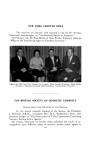
118 JOURNAL OF THE SOCIETY OF COSMETIC CHEMISTS usage conditions, the more we should be able to rely on the result which our test methods give us. It is on this note that I should like to close. I should like to urge all of you to give serious thought to the difficulties which may be encountered in development of test procedures and how to overcome them. We shall, of course, be interested in your opinion of the pH procedure we have out- lined and your suggestions as to any future procedures we should be work- ing on. The future of this program depends not only on the subcommittees but on the cooperation and help of the entire SOCIETY membership. SUBCOMMITTEE ON SHAMPOOS Dr. H. Henken, Caairma, S. R. Goff Dr. M. A. Goldberg E. Jarmus R. P. Reavey Dr. V. M. Votaw Mrs. M. Zeitlin THE TENTH MEDAL AWARD DECEMBER 10, 1957 Hotel Commodore, New York, N.Y. THE TWELFTH Annual Meeting of the SOCIETY OF COSMETIC CHEM- ISTS, December 10, 1957, ended with the Medal Award of the SOCIETY being presented to Dr. John H. Draize, Chief of the Skin Toxicity Branch, Division of Pharmacology, U.S. Food and Drug Administration, and a dinner-dance at the Hotel Commodore. Sabbat J. Strianse, retiring president, was chairman for the evening. He briefly reviewed the origin of the SOCIETY'S Medal and introduced earlier MedElists who were present. Dr. Donald H. Powers as toastmaster for the evening introduced those on the dias among whom were Dr. and Mrs. G. Robert Clark, Dr. and Mrs. John H. Draize, Mr. and Mrs. Sabbat Strianse, Mr. and Mrs. James H. Baker and Dr. and Mrs. Emil G. Klarmann. Dr. Powers then called on Dr. G. Robert Clark, Chief of the Division of Cosmetics of the Food and Drug Administration and Honorary Member of the SOCIETY, who presented his eulogy on Dr. Draize. President Sabbat J. Strianse in citing the MedElist said: "Dr. John H. Draize, I doubt if there is a single member of our SOCIETY who has not
Purchased for the exclusive use of nofirst nolast (unknown)
From: SCC Media Library & Resource Center (library.scconline.org)