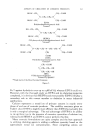
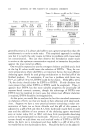
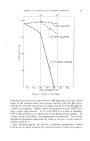
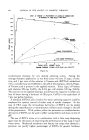
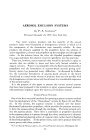
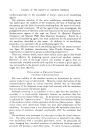
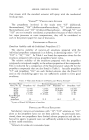
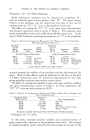
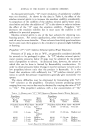
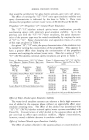
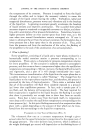
•_90 JOURNAL OF THE SOCIETY OF 'COSMETIC CHEMISTS ! i •.o! i I I I I Figure 1.--Drop size distribution. distribution of an insecticide, the median diameter is 25 microns, the largest particle size is about 65 microns, and only 1 per cent of the total weight will have particles smaller than 5 microns. The second method is presented by the frequency distribution curve, as shown in Fig. 2, for the same product. Here the abscissa is the drop diameter, and the ordinate is the per cent of the total weight of spray which has the corresponding drop diameter. The cumulative weight curve of Fig. I is essentially the integral curve of the frequency plot of Fig. 2, and therefore, knowing one plot the second. can be figured. Here again the particle size of about 2.5 microns constitutes the highest percentage of the spray weight of this particular product. On the cumulative weight per cent graph, a nearly horizontal line repre- sents a more uniform spray. On the frequency plot, a narrow, tall and •ROp DliltF.'l'• - liltlIONS Figure 2.--Frequency distribution of drops. symmetrical curve is obtained with a perfectly uniform spray. T•E S•^PE OF DRoPs The droplets expelled from the orifice have a high velocity near the nozzle they are decelerated by air resistance, and evaporate as they move away from the valve. The particle in its travel through the air

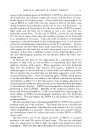
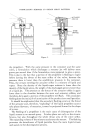
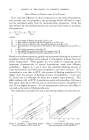
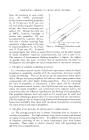
FORMULATING AEROSOLS TO OBTAIN SPRAY PATTERNS 291 takes, at first, a teardrop shape, then it becomes round, then elliptical (with the small axis in direction of flow), and finally it assumes a nearly perfect spherical shape until it strikes a surface or evaporates entirely. If any solids are in solution, the shape of the particles will be affected by the process of solidification. In formulations with high solids concentration swift evaporation takes place on the surface of the drop, resulting in the formation of a film, impervious to vapor, which causes ballooning of the drop when the internal vapor causes the film to expand. As a result, hollow particles are obtained. This effect can be observed in some poorly balanced hair sprays and hair lacquers. The size and also the temperature of the liquid drop in the aerosol spray decrease with the distance from the valve, due to evaporation. This is a simultaneous heat and mass transfer process in which heat for evaporation is transferred by convection and conduction from the air and from the liquid itself to the surface of the drop, and vapor is transferred by diffusion and convection into the air from the drop. FACTORS INFLUENCING THE ATOMIZATION OF AN AEROSOL In order to obtain a desired spray pattern for a given product one should be able to evaluate the influence of the following factors on the process of atomization: 1. The design of the valve and the actuator. 2. The pressure in the container. 3. Thermodynamic values--here combined under the term "flashing." 4. Physical and chemical characteristics: surface tension, density, viscosity and solubility. •!. The design of the valve and the actuator The spray distribution is affected by the shape and the size of the valve orifices. A noncircular, irregular orifice will atomize more easily than a round one, but the spray will not be uniform. A perfectly round orifice without any roughness around the edge or without scratches in the throat will give a uniform spray with an equal fraction of delivered quantity of the product in each quadrant of the spray cone. Also the size of drops expelled from a perfectly round orifice will be more uniform, and the average drop size will be larger. The smaller the orifices in the stem and in the actuator of the valve, the finer the spray. Too small orifices however, have a tendency to clog and should be avoided. 2. Pressure in the container The pressure has a significant influence on spray formation. In general, the higher the pressure, the finer the spray pattern and the smaller the spray particles. The pressure within the same container will depend upon
Purchased for the exclusive use of nofirst nolast (unknown)
From: SCC Media Library & Resource Center (library.scconline.org)