THE JOURNAL OF THE SOCIETY OF COSMETIC CHEMISTS This edition is published by THE SOCIETY OF COSMETIC CHEMISTS OF GREAT BRITAIN Publications Office: 54, Woodlands, London, N.W. 11. •) •96o Society of Cosmetic Chemists of Great Britain VOL. XI MAY 1960 4 THE RHEOLOGY OF PASTES, SUSPENSIONS AND EMULSIONS G. W. SCOTT BLAIR, M.A., D.Sc., F.R.I.C., F.Inst.P.* A lecture delivered before the Society on 19th October 1•5•. The flow and de2orma•ion o2 complex systems are generally re2erred •o simple pro•ogrpes: elastic springs, dashpo•s containing a viscous fluid and s•a•ic •ricfional elements linked •oge•her in series and in parallel. The ettec[s o2 concentration changes on viscosity and complex flow properties o2 emulsions, suspensions and pas•es are discussed. Many sysh•ms are so2•ened •emporarily (•hixo•rop•,) or permanently (rheodes•ruc[ion) by shearing, while some are hardened and some also "dilate." Measurements o2 s[ickiness and •hread-2orming capacity are described. The use o2 multivariate analysis 2or simplifying large batches o2 complex da[a is considered. RHEo•ocY •s defined as the study of the deformation and flow of matter. Unfortunately, the kind of matter with which we are concerned deforms and flows in very complex ways so, following the usual scientific procedure, we start by trying to describe our materials in terms of simplified prototypes: as Plato would have said, the ideal deformation and the ideal flow. We are rather fortunate here, in that there are quite a few real materials that approximate closely to these ideal modes of behaviour. Steel springs really do extend to a degree almost exactly proportional to the applied force, as postulated by Hooke in 1676 and water, alcohol, most oils and many * National Institute for Research in Dairying, Shinfield, Berks. 181

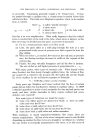
182 JOURNAL OF THE SOCIETY OF COSMETIC CHEMISTS other liquids follow Newton's law (1687) that the rate of flow is proportional to the driving pressure. When they went to damp certain machinery, engineers sometimes use a piston operating in a cylinder filled with oil, which is called a "dashpot", and rheo!ogists attempt to describe the behaviour of systems, which are only s!ight!y more complex than the models of Hooke and Newton, in terms of springs and dashpots linked in series and in parallel. The simplest of these, one spring and one dashpot in series, is called after Maxwell. Rather surprising!y, we have recently found • that clotted cow's blood very closely follows this model. If the two elements are linked in parallel, the system is completely elastic, but recovers slowly, the spring being damped by the dashpot. This model is generally named after Kelvin. Fig. I shows a generally very useful combination of the Maxwelt and Kelvin Bodies, called after the Netherlands rheologist, J. M. Burgers. Fig. 1 Much more complex models are often needed. An obvious addition is a static frictional element, like a heavy weight resting on a table. This is called a "St. Venant Body". If we add solid particles to a liquid, we get first a suspension and later a paste: if we add a liquid which remains suspended in the form of droplets, we get an emulsion. And this brings us to the subject of this lecture. Einstein calculated that, for very dilute suspensions having spherical particles, the viscosity of the suspension (*/s) divided by that of the liquid (*/1) should equal 1 + 2.5 •b, where •b is the volume concentration, so that should be independent of the size distribution of the particles. This is true only in exceptional cases and many modifications of the original equation have been proposed. Ward 2 quotes nearly fifty such equations. Only one need be mentioned here. Taylor 3 added a term to Einstein's equation, to apply to emulsions with small spherical particles where there is no slippage at the surface of the drops. Leviton and Leighton 4 applied this equation to creams and found it valid in cases where there appeared to be no clumping of the dispersed particles. Some other authors have not been
Purchased for the exclusive use of nofirst nolast (unknown)
From: SCC Media Library & Resource Center (library.scconline.org)