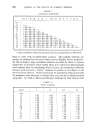
THE RHEOLOGY OF PASTES, SUSPENSIONS AND EMULSIONS 189 such factors are shown. The first factor is clearly by far the most important, corresponding approximately to overall "firmness". Test A is a sphere hardness test whose correlation coefficient with Factor I is .90. The other factors become progressively less important. Factor II is most nearly related to "crumbliness" (Q) as subjectively assessed. Enough has been said to suggest the possible usefulness in commercial practice of such forms of multivariate statistical analysis, however imperfect the existing methods may yet be. But it is clear that such methods are far inferior to the accurate determination of simple physical properties. The point is that in very many cases, such simple properties do not exist for the complex systems which we wish to study. Some of our more academic colleagues are apt to ask: "Why work with such complex things ?" We would remind them of a conversation which Plato gives us between the philosopher Parmenides and the young Socrates •*. Parmenides asks Socrates whether he is interested in "hair, mud, or dust, or any other trivial or undignified objects". To which Socrates replies: no, he is only interested in sublime things, and not at all in such unworthy objects. Parmenides rebukes him: "That is because you are still young, Socrates--and philosophy has not yet taken hold of you so firmly as I believe it will some day. You will not despise any of those objects then !" I do not know whether Socrates approved of cosmetics---but I feel sure that his biographer, Plato, would have approved of our subject ! ACKNOWLEDGEMENTS Figure 2 is reproduced by courtesy of the British Society of Rheology and the Editors of Nature, and Figure 3 by kind permission of J. & A. Churchill & Co. [Received ß 20th November-19591 REFERENCES Scott Blair, G. W., and Burnett, J. I•olloid Z. 168 98 (1960) Ward, S. G. J. Oil & Colour Chemists' Assoc. 38 9 (1955) Taylor, G. I. Proc. Roy. Soc. oeondon A 138 41 (1933) Leviton, A., and Leighton, A. J. Phys. Chem. 40 71 (1936) Bingham, E. C. and Green, H. Proc. 2/m. Soc. Testing Materials 19 640 (1919) Scott Blair, G. W. J. Rheol. 1 127 (1930) Scott Blair, G. W., Hening, J. C. and Wagstaff, A. J. Phys. Chem. 43 853 (1939) Nature 149 197, 702 (1942) Scott Blair, G. W. 2/ Survey of General and Applied Rheology, 2nd t•dn. (1949) (Pitman, London) Scott Blair, G. W. and Reiner, M. Agricultural t•heology (1957) (Routledge & Kegan Paul, London) Claassens, J. W. S. African •[. Agricultural Sci. 1 457 (1958): 2 89, 247 (1959) Stevens, S.S. Handbook of Experimental Psychology, Chapter 1. (1951) (Chapman & Hall, London)

190 JOURNAL OF THE SOCIETY OF COSMETIC CHEMISTS •a Baron, M. and Harper, H. Dairy Inds. 15 407 (1950) •4 Scott Blair, G. W. Oil 1 14 (1951) •* Cornford, R. Plato and Parmenides (1939) (Kegan Paul, London) DISCUSSION MR. P. ALEXANDER: It has been indicated by Rose C.R. and Cook W. H. in the Canariian Journa! of Research (1945) that the viscosity of carrageerdn in 0.05M NaC1 is a reliable measure of its suspending power in milk. is the choice of sodium chloride and concentration justified, and if so can such method be applied to forecast the suspending power of carrageenjn in other systems ? THE LECTURER: I am familiar with the paper quoted and the statistics given appear to be convincing but I should not like to say how far this principle can be extended to other systems. DR. J. }XT. CARRINGTON: Can the phenomenon that a greater force is required to pull a slider from a flat surface of butter then to move the slider along the surface be explained by the Bowden & Tabor !The Friction anri Lubrication of Soliris. (1954) (Clarendon Press, Oxford)j concept of friction ? The sliding movement in the plane of the surface would be expected to cause local melting of the points of contact at the butter/slider interface, thus lowering the interfacial shear strength. Relative interfacial movement in the plane of the surface would not occur when tension is applied normal to the surface and a greater force to cause separation would therefore be expected. THE LECTURER: A very excellent suggestion which is probably correct. MR. F. V. WELLS: Would not three factors be involved in the butter spreading estimation that would bring the cylinder-and-plunger test nearer [o normal domestic usage than the ingenious knife blade arrangement ? Firstly, the fact that the bread matrix is deformed by the user into a sort of semi- cylindrical trough, when the butter is pressed into and along it secondly, the variation in deformation of the butter, due to temperature changes in domestic use, and thirdly, proceeding from this, a more rapid rate of flow along the outer surfaces of the butter than at the central core, when the user's knife is applied ? All these phenomena would seem to be fairly adequately reproducible in the cylinder test. THE LECTURER: I agree that the mechanical spreader is not a perfect imitation of real spreading on bread. In the former the butter is probably not so drastically sheared. I do not follow the point about temperature. All tests and judgments were made in a constant temperature room and I doubt whether the rise in temperature caused by shearing would be consider- able. MR. C. PUGH: I would like to refer to the demonstration with corrnClour. When making some custard, I obtained a dilatant system due to having too little milk. This system was not sticky. On adding enough milk to destroy
Purchased for the exclusive use of nofirst nolast (unknown)
From: SCC Media Library & Resource Center (library.scconline.org)