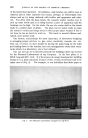
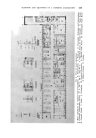
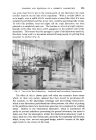
PLANNING AND EQUIPPING OF A COSMETIC LABORATORY 231 looked on as being analytical and also physical-chemical, is included in the biochemical department. The biochemist is h ained in radio-active techniques and so far as the work of this laboratory is concerned, the technique has been applied as yet only to biochemical problems. In biochemical work, of course, paper chromatography is one of the most important tools and the biochemists are available to carry out such work for other departments if there should be the need. The physiological and bacteriological departments are essentially de- pendent on microscopes. The department is also furnished with a complete microscope with photographic attachments and apochrornatic objectives which is normally only used by either the physiologist or the expert photo- micrographer, whose job it is to take ordinary photographs as well. On the other hand, certain apparatus, as, for example, the refractometer, the polari- meter and the spectrograph, etc., are housed, naturally, in the optical room and are available to such workers as rnay find the need to use them. Finally, mention should be made of the pilot or semi-scale plant which is housed on the ground floor away from the laboratory. This was done partly because of shortage of space but mainly because even small plant can produce vibrations which can affect delicate instruments in the laboratory. The room is 24 x 48 ft. and is fitted with all supplies, steaJn, hot and cold water, electricity, gas, pressure and vacuum. The plant includes various types of mixers, the maximurn capacity being of the order of 5 gallons. The mixers are designed so that fittings can be changed in order to investigate other modes of producing the final cosmetical product. It includes roller mills, special heavy mixers, a miniature type of votator, and hand-filling machines so that the products can be filled for storage and also testing by consumer panels. A fully equipped workshop is at hand to carry out alterations, any running repairs and also to act as a service centre for the various installations in the laboratory. It will be appreciated that in spite of the variety of disciplines which have to be catered for in dealing with cosmetical products and, indeed, the careful investigations that have to go oa in order properly to mix the ingredients of a formulation, it is reasonable to suggest that the layout of the laboratories gives pleasure to the scientific staff and, at the same time, fulfils the require- ment of high efficiency in the working. [Received: 7th April 19601

232 JOURNAL OF THE SOCIETY OF COSMETIC CHEMISTS SOCIETY OF COSMETIC CHEMISTS OF GREAT BRITAIN An Exhibition of Laboratory Gadgets was held at the Royal Society of Arts on 7th April 1960. The following were shown: A simple form of Tyndallometer for the investigation of colloidal phenomena of surface active agents, and cellulose derivatives, under various conditions. Designed and exhibited by Mr. S. Castles. This apparatus was designed to show evenness of fill and correct degree of compaction in Face Powder Compacts. The depth of penetration is recorded after 10 seconds for a given load and the measurement repeated in four equi-spaced positions on the compact. The load and the cross-section of the button may be changed according to require- ments. Designed and exhibited by Dr. H. W. Hibbott. This apparatus is used for the quality control of non-Newtonian emul- sions and gels. The method is to measure the rate at which a sample of the gel is drawn into a length of precision bore glass tubing by a slight vacuum, which may conveniently be about 70 cm. head of water. The trouble-free device for obtaining a constant suction consists of a water-pump connected to maintain a constant head of water in a tube about 2 cm. in diameter. The level of water at the bottom of the tube is maintained constant by running the water from the filter pump into a bowl from which it overflows into the sink. The upper level of water in the tube is maintained by the filter pump. The precision bore tube is chosen to suit the sample. to be examined and is usually 2 ft. long and between 1 mm. and 10 mm. diameter. It is clamped vertically and is connected by a short piece of rubber tubing through a two-way cock to the source of constant vacuum. The lower end dips into the sample to be tested. It is usually sufficient to keep the sample in a thermostat or constant temperature cupboard for temperatures near the ambient but, when greater accuracy is required, the precision tube also may have a constant temperature jacket. A most important aspect is that it can be completely defined
Purchased for the exclusive use of nofirst nolast (unknown)
From: SCC Media Library & Resource Center (library.scconline.org)