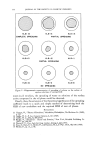
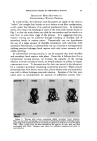
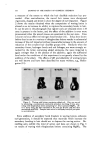
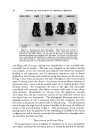
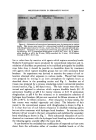
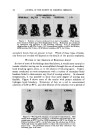
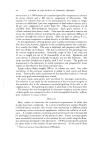
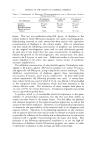
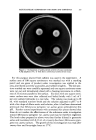
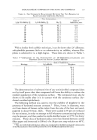
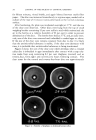
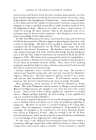
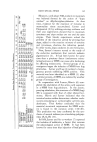
336 JOURNAL OF THE SOCIETY OF COSMETIC CHEMISTS a measure of the extent to which the hair disulfide reduction has pro- ceeded. After neutralization, the waved hair tresses were shampooed vigorously, shaped and dried to show the degree of curl imparted. Figure 2 shows the results obtained when the composition of waving lotion is altered so as to increase its ability to rupture the secondary bonds in hair. It can be seen in the photograph that tighter curls are obtained when 2 M urea is present in the lotion, and the effect of the additive is even more pronounced when the waved tresses are examined in the wet state. Urea is known to be an effective hydrogen bond breaker (13). It has been shown before that its use in a variety of thioglycolate lotions results in substantial increase of the curl imparted without measurable increase in the amount of reduction of the covalent hair disulfide groups (14). Similarly when the secondary forces, hydrogen bonds and salt linkages, are more strongly at- tacked by the lotion containing added ammonia, the wave imparted is again stronger than in the absence of the additive again the sulfhydryl level under the conditions of this experiment is not greatly altered by the addition of the alkali. The effects of pH and alkalinity of waving lotions are well known and have been described by many workers, e.g., Hellin- gotter (15). s, LVEL-- I o.2 I 077 i 0.20 Figure 3.. Waving with lotions containing added salt. Hair was waved by simulating a conventional commercial procedure involving 15 min. proc- essing with thioglycolate lotion containing 0, 1 M or saturated MgSO4. Af- ter a water rinse, the hair remained on the rods for 30 min. and was then neutralized with H.,O.•. Samples were taken for sulfhydryl analysis just prior to neutralization. Since addition of secondary bond breakers to waving lotions enhances curl generation, it should be expected that materials which increase the secondary bonding in hair should act to depress the waving action. De- swelling salts exhibit this kind of action and data are shown in Fig. 3 on results of waving with thioglycolate lotions containing MgSO4. The

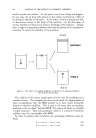
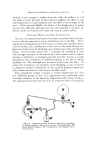
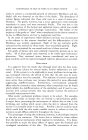
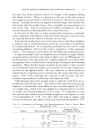
MOLECULAR FORCES IN PERMANENT WAVING 337 decrease in curl strength is readily observed while the addition of 1 M salt tends to lower the level of hair reduction slightly, the effect of sulf- hydryl generation is s•nall co•npared with the effect on the strength of the wave. With saturated MgSO4, the ability of the thioglycolate to reduce the hair has definitely decreased, but the curl i•nparted is virtually nil. Similar results are obtained with other salts such as sodium sulfate. SECONDAI•¾ BONDS AND CURL STABILIZATION Thus far, the experimental results have been concerned with secondary forces in the wave generation step in which lotion acts on the fiber. If it is argued that during generation of the wave, covalent and secondary bonds must be broken, then stabilization of the wave in the newly formed con- figuration should occur by rebuilding some of these same types of molecular bonds. Conventionally waved hair is stabilized by rebuilding of cross links through treatment of the reduced hair with oxidants such as sodium bromate or perborate, or hydrogen peroxide, and this reaction is usually described as the re-oxidation of sulfhydryl groups in the hair to reform disulfides (16, 11b), although new secondary bonds must also form. To isolate the contribution of secondary bond rebuilding, it was of interest to determine whether stabilization of curl could be produced experimen- tally without reformation of the keratin disulfide bonds. Since atmospheric oxygen is known to oxidize thioglycolate ion (11a) and sulfhydryl groups in hair (17), experiments were performed under anaerobic conditions in the apparatus diagrammatically shown in Fig. 4. The apparatus permitted reinoval of air by alternate cycles of evacuation Figure 4. Apparatus used for waving in oxygen free atmosphere. (A) waving chamber (B) hair tress on rod (C) transfer flask (D) reserve pressure chamber (E) to manometer (F) to helium (G) to vacuum pump.
Purchased for the exclusive use of nofirst nolast (unknown)
From: SCC Media Library & Resource Center (library.scconline.org)