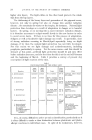
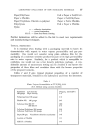
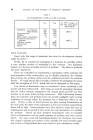
MONO-ESTER CONTENT OF PROPYLENE GLYCOL MONOSTEARATE 1T Proposed Chromatographic Method In order to determine the mono-ester content of a sample of P.G.M.S., adsorb one gram of the sample on to a silica gel column at least 6 in. length • in. diameter. Elute with at least one litre of benzene. Evaporate the eluate and weigh. Repeat the procedure with further 100 ml portions of benzene, until the distilled residue is of constant weight. By simple calculation, determine the amount of residue as percentage di-ester. Now elute as before with about 250 ml of diethyl ether to desorb the stearic acid and mono-ester. Determine the acid value of this residue and calculate the mono-ester content by difference. Typical Results Sample 4 (i) Mono-ester content by hydroxyl value--74.8% w/w (ii) Mono-ester content using 12 in. column calculated as follows :-- Di-ester content-- 24.2% w/w Mono-ester content + free stearic acid--75.3% w/w Stearic acid content-- 0.5ø/0 .'.Mono-ester content-- 74.8% (iii) From similar determination mono-ester content--75.5% (iv) Mono-ester content using 6 in. column-- 74'7% As already stated in the hydroxyl value method, it is necessary to collect inter-laboratory results on test samples to determine the reproducibility of the method. As before, these results are not yet available. Results obtained when such a test sample was issued to two experienced operators in the same laboratory are shown in Table $: Table 3 Operator 1 Operator 2 Sample 3 43.8% 45.4% Sample 3 43-9% 43-9% -- 44-8% The results shown in Tables 2 and $ were determined on the same test sample. CONCLUSIONS Both the acetylation and the chromatographic methods are improvements on the periodic acid oxidation method and are sufficiently promising to warrant more exhaustive examination of their accuracy of reproducibility.

18 JOURNAL OF THE SOCIETY OF COSMETIC CHEMISTS Possibly the chromatographic method is to be preferred since it needs less skilled operation than the acetylation and it does not involve any risk of interchange of stearic acid by acetic acid in the ester. An additional feature is that only about 1 hour of an analyst's working time is consumed compared with over 3 hours for the hydroxyl value method. ACKNOWLEDGMENTS The authors' thanks are especially due to Dr. A. W. Middleton for his continued interest, help and advice in this work. We should also like to thank the Directors of Chesebrough-Pond's Ltd. for giving their permission to present this paper. (Received: 24th June 1960) REFERENCE • Quinlin, P., and Weiser, H.J. y. Am. Oil Chemists' Soc. 35 (1958) 325. DISCUSSION Introduction by W. P. Pepper It will be useful to give an indication as to how it came about that we took a keen interest in the question of analysis of propylene glycol mono- stearate. Probably most cosmetic chemists taking an interest in this material for the first time regard it as being rather similar to the mono- glyceride of stearic acid and having had experience of the T.G.A. met[Jod using periodic acid and finding that it gives consistent results, they turn to a similar method for dealing with propylene glycol monostearate. There is, however, a much greater difference between these materials from an analytical point of view than one at first realises. Periodic acid reacts with hydroxyl groups on adjacent carbon atoms, for example, corresponding to the monoester of GMS and these are the only hydroxyl groups which are readily subjected to oxidation. By direct treatment of the sample with periodic acid, the monoester content is directly estimated by the difference between two titrations the difference between that of the blank and that of the sample. A small error in titration will only produce a small error in the calculated result. With propylene glycol monostearate, only one free hydroxyl group occurs in the monoester. Consequently, the free glycol content must first be estimated and then the combined glycol content after hydrolysis. Assuming the parent stearic acid to have a molecular weight of 270, then the molecular weight of pure propylene glycol monostearate is 328, the propylene glycol content corre- sponding to this is 22.13% and that which corresponds to the pure distearate is 14.39ø/0 . The difference between these figures is only 8.78ø/0 and that
Purchased for the exclusive use of nofirst nolast (unknown)
From: SCC Media Library & Resource Center (library.scconline.org)