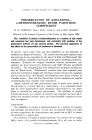
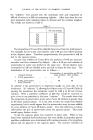
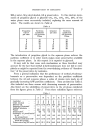
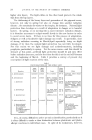
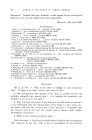
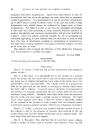
6 JOURNAL OF THE SOCIETY OF COSMETIC CHEMISTS the "solution" were poured into the membrane tube and suspended in 150 ml of water in a 250 ml measuring cylinder. After four days the two were separated, both solutions taken to dryness and the residues weighed. The results are shown in Table 8. Table $ Per cent Soluble «% 21.5 1% 16.6 2% 16.8 3% 15.5 4% 13.8 5% 14.9 The proportion of Tween 80 in colloidal form is less than the total present. For example, for the 2 per cent mixture, only 1.66 per cent will be present in the disperse phase. Therefore proportionately less preservative will be lost to the aqueous phase. A 2 per cent solution of Tween 80 in the presence of 0.15 per cent pre- servative was then examined by dialysis. Also a 0.15 per cent solution of preservative in water was treated in the same way. 50 ml solution were surrounded by 150 ml distilled water and left to stand for four days. The distribution of the preservative was as follows :- Concentration of preservative mg/100 ml Original Solution Inner Solution Outer Solution 1. 0'15% preservative ...... 37 37 2. 0'15% preservative ...... 46 32 2.0% Tween 80 ........ In solution 1 the preservative is dispersed equally on each side of the membrane. In "solution" 2, allowing for 16.8 per cent of Tween 80 (Table 3) passing the membrane the remainder would be 0.83 g in 50 ml of inner solution. With a partition coefficient of 250 this would be expected to give a two to one partition in the inner "solution" The results show that the proportion of preservative in the outer Tween 80 solution is greater than in the inner aqueous phase. It is not wise to infer too much from limited experiments, but it would appear that the preservative may be more soluble in a true solution of Tween 80 than in water. If so this will serve to reduce still further the loss of preservative from the aqueous phase. This point would repay further study. So far the aqueous phase has consisted of water only. When it was found that methyl p-hydroxybenzoate was very soluble in propylene glycol, partition coefficients were determined with varying amounts of (a) propylene glycol and (b) glycerol in the aqueous phase. The mixture consisted of

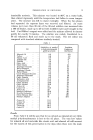
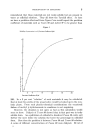
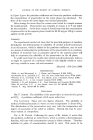
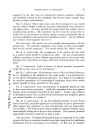
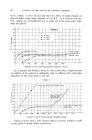
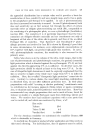
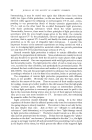
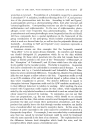
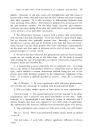
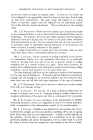
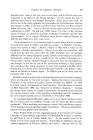
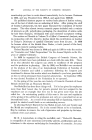
PRESERVATION OF EMULSIONS 7 200 g water, 50 g o!ey! alcohol, 0.3 g preservative. To this mixture incre- ments of propylene glycol or glycerol--2%, 5%, 10%, 15%, 20% of the water phase--were successively included, replacing the same amount of water. The results are shown in Table 4. Table 4 Propylene Partition Glycerol Partition Glycol Coefficient per cent Coefficient per cent Oil/Aqueous Oil/Aqueous Phase Phase 0 31 0 31 2 29 2 29 5 22 5 26 10 19 10 26 15 18 15 27 20 16 20 26 The introduction of propylene glycol to the aqueous phase reduces the partition coefficient or in other words makes more preservative available in the aqueous phase. In this respect it is superior to glycero!. It may well be that some such mechanisms as those described may account for the fact that methyl p-hydroxybenzoate does not fail so com- pletely as might be expected from the overwhelming evidence of "deactiva- tion" of the preservative by nonionics. From a general indication that the performance of methyl p-hydroxy- benzoate as a preservative was dependent on the partition coefficient between the oil and aqueous phases a series of creams were made up of gradually increasing O/W partition coefficients. They are listed in Table 5. Also included are three creams with decreasing amounts of preservative. Also listed are the solubilities of preservative in the oil phase calculated from the figures given in Table 1. From these solubility figures reference Table 6 A B C D E F G H I Lanbritol .... 5 5 5 5 5 5 5 5 11.5 Cetyl Alcoh•)i .... 8 8 8 8 8 8 8 8 1.5 Mineral Oil .. 19.5 19.5 19.5 13.5 8.5 .... Isopropyl Myristat•' .. -- -- -- 6 11 19.5 11 6 2.5 Diethyl Sebacate .... -- ..... 8.5 13.5 17-0 Water .. 100 100 100 100 100 100 100 100 100 Preservative .25 .2 .15 .15 .15 .15 .15 .15 .15 Solubility of preservative in oil 6.6 6.6 6.6 8.0 9.3 11.4 17-4 20-9 24.8 (by propdr'tion) .... Partition CoefficientO/W 13.5 13.5 13.5 16.0 18.4 22.5 36.5 46.2 62 (from the graph) Preservative mg/100 water 44.3 37.1 27-8 24.2 21-5 18-0 11.6 9.4 7.1
Purchased for the exclusive use of nofirst nolast (unknown)
From: SCC Media Library & Resource Center (library.scconline.org)