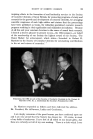
JOURNAL OF THE SOCIETY OF COSMETIC CHEMISTS to my parents. On top of this, there is the environmental factor which has enabled me to do many things which in other circumstances I could never have even attempted. In my earlier days, I had the urge to publish and every facility to do so was given by the British Leather Manufacturers' Research Association. What I would claim, however, is that I made the effort and succeeded in joining the Beecham Group and in particular the fiIm now known as County Laboratories Limited. Such eminence as I may have attained--and this Medal is the crowning glory--is in the main due to the far-seeing and intelligent outlook of my erstwhile employers. Without the facilities so freely given I could have done little and I would in thanking you all pay homage to County Laboratories and the top level directorate of Beecham Group Ltd. Perhaps I might make one observation which is culled from a remark made by an A•nerican who is probably well known to you all. I refer to the doyen of the "Ball Game" Casey Stengel who, on reading the press notices about his retirement, said, "I thought a guy had to die to get all these things said about him." LOOKING TO THE FUTURE R. H. MARRIOTT, D.Sc., F.R.I.C. It seemed to me that on this occasion, it would not be out of place to speculate on the future of our industry as a branch of applied science. In so doing, no pretence is made that complete coverage is even attempted. rather will the address be extremely limited and indeed deal with only three main topics. Two of them arise from the British Congress of Cosmetic Science, which as you know was held in London some eighteen months ago. At that meeting attention was drawn to the psycho-somatic function of cosmetics in direct contradistinction to dermatology. This notion was not entirely new. For example, Ralph G. Harry in the third edition (U.S.A.) of his book Modern Cosmeticology (1947) alludes to "a flick of the powder puff, or a new dress, may prove of more value to a tired and depressed house~ wife than a cartload of medicine" while Marriott in 1949, stressing the need of cosmetics, suggested that although a face "make-up" might not cure fallen arches it can give buoyancy to the individual. Later in dealing with "Cosmetics as a Factor in Civilization" he made the point that a new "hair-do" might reduce the need of tranquillizers! It became quite clear from the papers which were read at the Symposium on "The Biology of Hair Growth" held in London in 1956 that hair growth and its loss was in some way connected with hormones. The supply of these substances is controlled by the nervous system and an imbalance might quite well have an effect on the hair, especially that of the scalp. To such

SOCIETY OF COSMETIC CHEMISTS 53 people who become concerned by excessive hair-fall, any nervous upset which may be present will be accentuated and could well increase the balding process. Of course, the upset may be due to the aftermath of an illness-- but if the hai• once more begins to grow, whether by design or simply chance, the health of the individual will markedly improve. That the psychological factor is being more appreciated was shown by the first two papers read at the First International Congress sponsored by the I.F.S.C.C. and held in Munich three months ago. The first contribution was a notable attempt to correlate odour or fragrance with psychological reactions, while the other dealt with the psy&•osomatic effect of cosmetics on ailments of the skin. While it is true to say that cosmetics with a physiological action may indeed be important and even necessary, it is, nevertheless, safe to suggest that investigations following the psychological theme can lead to great improvements in the form and functioning of toilet goods and in doing so create a greater acceptance of them throughout the whole world. Such work could undoubtedly lead to a better interpretation of consumer testing. This leads us on to a problem which must sooner or later be tackled, namely, how to devise experimental laboratory methods for evaluating quality in cosmetical products. At the London Congress, H. van Dool discussed the "Evaluation of Perfumery Raw Materials" pointing out that adulteration of, for example, essential oils could, from a purely ethical standpoint, be looked on as an abuse but, in fact, it may prove to be a way of democratizing life in that it can make accessible to the lower income groups products equivalent to those which were formerly expensive luxuries available only to the wealthy. In other words, such a procedure would not really be adulteration. D. Powers presented a paper specifically in respect of Shampoos. He endeavoured with some success to show that there were certain features appreciated by users which could be related to some of his laboratory results. The real difficulty arises because user acceptance depends on indefinable properties and these can be described only in a comparative way by phrases such as "fragrant as a rose, soft as a petal, smooth as silk, velvety as a peach" and so on. All these terms are understandable, but they have little quantitative meaning. The equating of laboratory assays with the conscious reaction of the user can be solved when the mechanism of nerve stimulation is understood. This is an important link. Of course, it is necessary that laboratory tech- niques must be available to detect and measure the ingredients in a com- position and to assay their individual and composite effect when applied to a tissue in which a nervous system is present. An important paper was given by R. K. Winkelmann at the Seminar
Purchased for the exclusive use of nofirst nolast (unknown)
From: SCC Media Library & Resource Center (library.scconline.org)