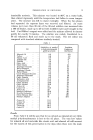
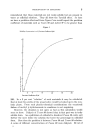
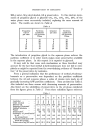
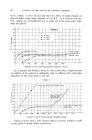
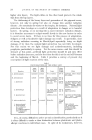
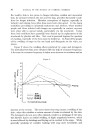
8 JOURNAL OF THE SOCIETY OF COSMETIC CHEMISTS to Figure 1 gave the partition coefficients and from the partition coefficients the concentration of preservative in the water phase was calculated. For three of the creams the latter figure was checked physically. After storage for seven days the creams were tested in a simple manner for mould growth. Preservation was complete in creams A to F and failed for the remainder. So for these creams it would seem that the concentration of preservative in the aqueous phase should be 20-25 mg per 100 g to ensure against mould growth. Summary The experiments carried out show that for practical purposes of emulsion formulation the determination of solubility of methyl p-hydroxybenzoate in an oil mixture, which is related to the partition coefficient, may be used as a means of estimating the performance of the preservative in an emulsion. Addition of materials such as propylene glycol to the aqueous phase will help to counteract the solubility of the preservative in the oil phase. It would seem from the results that methyl p-hydroxybenzoate behaves as might be expected of a substance which is only slightly soluble in water and very soluble in many oils and nonionics. (Received: 27th June 1960) REFERENCES • Bolle, A., and Mirimanoff, A. J. Pharm. and Pharmacol. 2 685 (1950). • de Navarre, M. G., and Hall, S.C. Proc. Sci. Sect. Toilet Goods Assoc. 27 29 (1957). a Wurster, D. E., and Rath, D.W. Am. Pharm. Assoc. Convention, Boston (1954). 4 Wedderburn, D.L. J. Soc. Cosmetic Chemists O 210 (1958). 5 Beckeft, A. H., and Robinson, A.E. Soap, Perfumery and Cosmetics $1 454 (1958). 6 Barr, M., and Tice, L.F. J. Am. Pharm. Assoc. Sci. Ed. 45 465 (1954). ? Arkins, F. Mfg. Chemist 21 51 (1950). •DISCUSSION MR. F. ATKINS: The solubility of the preservative in mineral oil is given as 0'2%. A partition coefficient of 0'3 seems rather low. THE L•CTURER: Those were the figures obtained. The solubility of methyl p-hydroxybenzoate in water at room temperature is about 0'3%. The distribution of the preservative may vary with the temperature and degree of association of the solute in solution. Mineral oils may be some- what variant in composition. DR. A.M. POSNER: Following the query of Mr. Arkins, it seems that the partition coefficient as derived here, which is strictly a thermodynamic function, will vary with concentration except in dilute solution. Therefore activities in place of concentrations should be used. This seems to be

PRESERVATION OF EMULSIONS 9 supported by the fact that the relationship between partition coefficient and solubility is linear at low solubilities but deviates quite strongly from linearity at high concentrations. MR. F. 2kTKINS : When these esters were first introduced it was stated that the Rideal Walker coefficient increased substantially from methyl to the higher esters. On these grounds the propyl ester was widely used in manufacturing practice. My experience has been that the propyl ester is useless for the preservation of certain stearate creams, presumably due to increased solubility in oils and reduced solubility in water. Has Dr. Hibbott any evidence which supports this view ? THE LECTURER: We carried out a few parallel determinations with the propyl ester. The partition coefficients were twenty to forty times higher than for the methyl compound. This would confirm Mr. Atkins' views. MR. M. G. DENAVARRE .' My compliments to the authors for this work on a subject which should be studied more often. The use of regenerated cellulose membrane in these dialysis experiments may be the reason why the figures for Tween 80 do not agree with those of Kostenbauder who used nylon. DR. J. CARRINGTON' Nylon is known to absorb phenolic compounds. Could this be the cause of the discrepancy ? MR. M. G. DENAVARRE ' Kostenbauder knew of this and made allowance for it. Referring to the additions to the water phase, I was interested to see the effects of propylene glycol and glycerol. In a paper to be published we describe experiments by bacteriological techniques which show results almost parallel to those described in this paper. DR. J. CARRINGTON ß Low concentrations of propylene glycol are said to have preservative properties. Could this reputation have been gained because of the mechanism described in this paper ? Is there any evidence of synergistic action when methyl p-hydroxybenzoate and propylene glycol are present together in a system ? MR. M. G. DENAVARRE ß In our bacteriological studies we have found that at least 18% propylene glycol per se is necessary to give a effect against the organisms we used and glycerine was not preservapreservative even at 46%. We contend that variant results are obtained because many bacterological studies are of far too short duration. For cosmetic products observations should be made for at least a year. THE LECTURER ' If methyl p-hydroxybenzoate is completely in the water phase at the time an emulsion is made it may take a long time for equilibrium distribution between the phases to be attained. In this way an emulsion
Purchased for the exclusive use of nofirst nolast (unknown)
From: SCC Media Library & Resource Center (library.scconline.org)