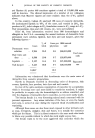
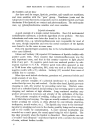
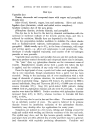
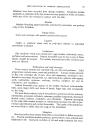
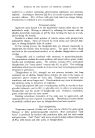
36 JOURNAL OF THE SOCIETY OF COSMETIC CHEMISTS volumetric flask, washing in with water, and make up to volume. Pipette 25 ml of this solution into a 250 ml separating funnel, add 20 ml 95% alcohol and then 50 ml 6'8•o ptoluidine hydrochloride from a pipette. Add 50 ml carbon tetrachloride, insert stopper and shake for five minutes. Allow to separate and run off the lower layer into a 500 ml conical flask containing 100 ml alcohol, which has been neutralized to the mcresol purple indicator. Titrate with 0.1N alcoholic potassium hydroxide to the first change from yellow to grey-purple and record the volume of titrant used its r 1. To the liquid remaining in the separating funnel add 25 ml carbon tetra- chloride and shake for two minutes. Allow to separate, run off the lower layer into the same 500 ml flask and again titrate with alcoholic potassium hydroxide. Record the volume used as V2. Repeat the whole of the above procedure, omitting the detergent, and record the volume of alcoholic potassium hydroxide corresponding to the sum of the two titrations as C. This volume is a measure of the solubility of ptoluidine hydrochloride and must be subtracted from the sample titration. (v-c) x f x $0 34_1. 0.00231 solution per gram.: w whereV =V• d-V2 f : factor of 0.1N alcoholic KOH. w : weight of sample in 25 ml solution. C = blank titration of 50 ml ptoluidine HC1. Comments. This method, which was investigated as a possible alterna- tive to the methylene blue titration, also depends on the formation of an anionic-cationic complex, but in this case the acidic complex is extracted and titrated with standard alkali in alcohohc solution. The method was originally described by 31arron and Schifferli (5) and consists essentially of the addition of a solution of the reagent in water to the alkyl sulphate solu- tion, and the subsequent extraction of the complex with carbon tetrachloride in a separating funnel. The carbon tetrachloride extracts are collected in a flask containing neutralized alcohol and titrated with 0.1N alcoholic potash, using mcresol purple as indicator. R.SOaO31 d- CHa.C6H4.NH•.HC1 = CHa. C6H•.NH•.R.SOaOH d- 31C1 CHa.C6H4.NH•..R.SOaOH d- KOH = R. SOaOK d- CHa.C6H4.NH• d-H20 A suitable modification of this method was worked out and this is des- cribed fully in the prev/ous section. The method was chosen since it had been found to give satisfactory results in at least one laboratory, where it had been in use for a number of years, and because the end-point seemed to be more definite and the conditions less critical than those experienced with

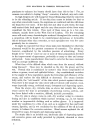
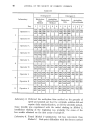
PRELIMINARY NOTES ON THE DETERMINATION OF ANIONIC SULPHATES 37 the Epton method. It was hoped that the method would give rise to less operator to operator variation than the method described under 1.2 above. A further advantage of this method is the ease with which the titrant can be standardized. EXPERIMENTAL 2.1. Initial Experiments with the Methylene Blue Method Experiment 1 A solution containing 2.815 g of a commercial triethanolamine lauryl sulphate was prepared. Aliquots of this solution were titrated with the same standard 0.002M cetrimide solution, using slight variations in technique. All the titrations were carried out by the same operator and the •esults, expressed as m! 0.002M cetrimide per gram of sample, are the average of two or three titrations. The results are shown in Table I. These experiments show that a considerable error can be introduced by varying the size of the aliquot taken, even though it is diluted to 25 ml before titrating. Running in 80% of the titrant in one addition does not seem to affecl the result, providing the mixture is adequately shaken before the addition. Table I Effect of technique on methylene blue titration. Technique 1. 25 ml aliquot: small additions throughout. 9.. 25 ml aliquot: after shaking vigorously, 80% titrant added in one lot before re-shaking. 3. As in 9., but adding 80% titrant before shaking. 4. As in 9., but making 90% addition. 5. As in 3, but making 90% addition. 6. 15 ml aliquot: small additions throughout. 7. 15 ml aliquot: titrant added as in 2. 8. 15 ml aliquot: titrant added as in 3. ml 0.002M/g 454 452 458 454 456 446 447 453 Experiment 2 To check the effect of the ratio of the volume of aqueous phase to the volume of chloroform phase, two series of experiments were undertaken by a second operator. In both these 5, 10, 15, 20 and 25 m! aliquots of the same artionic solution were titrated with a standard cationic solution accord- ing to the method given in section 2.1. In the first series, the conditions were so arranged that the ratio of aqueous to chloroform phase was the same at the beginning of each titration, while in the second series this ratio was constant at the end of each titration.
Purchased for the exclusive use of nofirst nolast (unknown)
From: SCC Media Library & Resource Center (library.scconline.org)