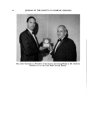
J. soc. cos. CHEM. 15 71-73 (1964) COSMETIC CHEMISTS IN THE R&D EXPLOSION BY ANTHONY M. SCHWARTZ, PH.D.* Mr. Chairman, honored guests, and fellow members of the SOCIETY or COSMETre CHEMtSTS: I am deeply appreciative of this Award and want first of all to express my heartfelt thanks to all of you who have given it to me. I feel especially honored to be joining the group of past recipients, a group that includes so many illustrious contributors to cosmetic science. I welcome also this opportunity to thank my co-workers and my company, Harris Research Laboratories, without whose continuous support I certainly would not be here receiving this Award this evening. Finally, I want to thank all those who have worked in arranging this very festive affair. My expression of gratitude on this occasion will depart just a little bit, I believe, from the traditional. Instead of talking about some aspect of cosmetic chemistry, its achievements, its potentialities or its future, I am going to talk about cosmetic chemists--about us scientists and technologists who are now or will be in the future a part of the cosmetic industry. Per- haps we can explore a few thoughts, which I hope will be appropriate, on our responsibilities, our opportunities and our avenues for growth and service in this era of rapid change. The change I have in mind is, of course, the tremendous growth of science which started with World War II and has continued at an accelerating pace ever since. The founding of this Society of Cosmetic Chemists was largely stimulated by the early stages of this growth, so the general philosophy of my remarks will not be new. It is pretty much contained in the articles of faith of this organization, both written and understood. As professional scientists working for individual companies within this industry, our re- sponsibilities can be grouped into two broad categories. One is to provide advanced technology and technical information for the growth of our com- panies and the industry. Along with providing sound technical guidance to management, this constitutes our internal responsibility. Our second, or exlernal, responsibility is to attract, recruit, train and indoctrinate the best young scientists we can find to be our co-workers and successors. Certain aspects of the explosion in R&D activity, paced by the require- * Harris Research Laboratories, Inc., Washington 11, D.C. 71

72 JOURNAL OF THE SOCIETY OF COSMETIC CHEMISTS ments of defence and space exploration, have made both these jobs increas- ingly challenging. Our internal responsibility requires that we maintain our personal technical competence and judgment at the highest level. The very bulk of new developments, however, is rapidly making it impossible for any individual to be thoroughly informed in all fields of interest to the cosmetic industry. Cosmetic science has become highly diversified and interdisciplinary to a point that few would have predicted when the Society was founded. It now involves large areas of physical and colloid chemistry, organic chemistry, theology, polymer science, biochemistry and phar- macology, to name just a few. It also encompasses many mechanical arts and even mathematical areas such as statistics and computation. In a short while we can be sure this list will be expanded still further. The scientific literature relating to all these areas has grown to a state where it is surveyable only in small sections, despite the solid advances that have been made in information retrieval. Thus, the problems themselves have become more complex, and the tools with which we attack them are more difficult to locate. This situation can be met and fought in a number of ways. One, which I'd like to mention briefly, is the team concept. Here the individual sci- entist expands his expertness in a relatively restricted area but maintains an awareness and a reasonable understanding of other areas involved in the team effort, so that he becomes an effective team member. This approach requires not only good experimenters but good leaders and offers great opportunities for leadership at all levels. Effective team leaders, in addition to being broad-gauged scientists, must learn many of the man- agerial arts. It is noteworthy that more and more companies in this industry have at least one man of technical background in their top manage- ment group. Thus our internal challenges in cosmetic research open up new internal opportunities, a fortunate situation which doesn't by any means exist in all industries. With regard to attracting and training good men, the challenge may be even greater than it is internally. We have certainly come a long way since the late Emil Klarmann, in his 1947 Presidential address to this Society--then two years old--remarked on the "existence of an attitude in some quarters that treats our industry and the efforts of its technical staffs with some condescension, or even worse." This is no longer a problem, thanks very largely to the efforts of this Society and its individual members and their achievements. But the R&D explosion has brought several new problems and intensified some old ones. First of all, much of the new basic knowledge and many of the new experimental techniques have been de- veloped in the academic world. The best graduate students come "factory equipped" with this knowledge, putting both them and their teachers in considerable demand. The young graduate is offering his services in a seller's market.
Purchased for the exclusive use of nofirst nolast (unknown)
From: SCC Media Library & Resource Center (library.scconline.org)