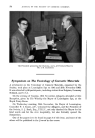
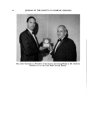
J. soc. cos. CHEM. 15, 67-70 (1964) DR. ANTHONY M. SCHWARTZ, THE SCIENTIST AND THE MAN EULOGY BY ALFRED E. BROWN, Pn.D.* It is a great pleasure for me to be here tonight to participate in the Award ceremony for Dr. Anthony M. Schwartz. It is my pleasant task tonight to tell you about him as a scientist and a friend and colleague whom I have known for about 18 years. He is known to all of us as "Tony," and he is probably best known to most of you as the senior author of the two- volume monograph, "Surface Active Agents and Detergents." Incident- ally, there is an old saying that probably every man in America thinks he can easily write a book and successfully run a restaurant. Well, Tony is one of those who has written a book, not once, but twice, and it has been one of the most successful technical books published in America in recent years. And I might add that he has been too busy to think about running res- taurants ! There is a lot of talk nowadays about interdisciplinary approaches to solutions of complicated problems in space, medicine and biG-physics, as if this were a new idea. Few who talk that way realize that cosmetic science has been interdisciplinary in scope for at least two decades. Cosmetic science encompasses every branch of chemistry, dermatology, biological sciences and even physics. Our Medalist and his father, the late Dr. Louis Schwartz, the famous industrial dermatologist, who was also a member of the SOCIETY OF COSMETIC CHEMISTS, are examples of scientists who actually span the spectrum of cosmetic sciences. Dr. Louis Schwartz worked in dermatology at one end of the spectrum of cosmetic science, and his son Tony works in broad chemical areas at the other end. Tony's dad, whom I also knew for many years, was a pioneer in industrial dermatology, having served with the U.S. Public Health Service for 41 years. Early in Tony's career, his father, who was strongly oriented to- ward chemistry, stimulated his son's interest in the effects of chemicals on the skin. Tony still vividly recalls chats with his father during the early thirties about problems such as penetration of skin by chemicals, skin irritation, photosensitization of skin by dyes, and, in a sense, these dis- cussions were Tony's first exposure to some challenging problems of cos- metic science. * Harris Research Laboratories, Inc., Washington 11, D.C. 67

68 JOURNAL OF THE SOCIETY OF COSMETIC CHEMISTS Tony was born in 1908 and, as the child of a Public Health Service doctor who traveled widely throughout the world as part of his duties, Tony led an interesting life during his formative years. After attending schools in New York City, he enrolled at Cornell, where he received his B.S. and then his Ph.D. degree in Organic Chemistry in 1931. What a year for a new graduate in chemistry to look for a job! An achievement of which Tony is very proud, and properly so, was his ability to obtain a research position in the chemical industry with National Aniline in that depression year. There, Tony made important pioneering contributions to the infant synthe- tic detergent industry as part of the group working with Dr. Flett. He worked on organic synthesis, dyestuff chemistry and synthetic detergents and their characterization. In this early period Tony showed signs of the characteristic that is so prominent in his career--his ability to work in and master a wide variety of technical fields. He joined the Visking Corporation in 1940 as a research supervisor and continued to broaden his technical scope by working on a series of interest- ing and important projects involving films in food packaging. During this period he also had a leave-of-absence at the University of Chicago to work on the Manhattan Project on problems involving separation of isotopes. Tony then joined the Alrose Chemical Company as research director during a period which marked a turning point in his career. Here he was exposed to broad areas of applications of specialty chemicals, and this experience greatly whetted his interest in the detergent and cosmetic fields. Although Tony had previously been exposed to the large-volume detergents (alkyl aryl sulfonates), he now became aware not only of the diversity in the detergent field but also of the large number of industrial applications of these compounds. However, he was forced to learn about this field the hard way, by going to individual publications and by speaking to individuals involved, and he found the lack of a source book a serious handicap. At this time he fully realized the usefulness of having such a text, and the germ of the idea of writing one was born. In late 1944 he became a member of the small group which Milton Harris was just assembling as an independent laboratory. Here Tony had the opportunity to be part of a young group under enthusiastic leadership and also to work in a rapidly growing field--detergent science and technology as applied to the cosmetic industry. Some pioneering work on applications of detergents in liquid and creme shampoos, conditioning rinses, and anti- dandruff rinses was performed during this early period. Another SCC Medalist, Ray Reed, was also a colleague at this time. Tony's contribu- tions over the years have been legion. He has directed many projects involving surface chemistry and physics, colloid chemistry, and detergency, covering many aspects of cosmetics and problems in the textile and allied chemical industries. He has over 30 publications and patents to his credit,
Purchased for the exclusive use of nofirst nolast (unknown)
From: SCC Media Library & Resource Center (library.scconline.org)