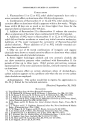
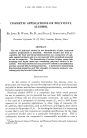
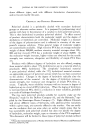
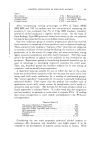
330 JOURNAL OF THE SOCIETY OF COSMETIC CHEMISTS ducts, in addition to approving its use in a variety of packaging applications (7, 11). Perhaps the most recent endorsement of the safety of PVA is to be found in the recent introduction of a new prescription product which contains 1.4ø7o PVA and is intended for routine instillation into the human eye. This certainly is an excellent testimonial to its safety for use. FORMULATION STUDIES Some of the main applications of PVA to cosmetic use can best be il- lustrated by a report of laboratory experiments. In cosmetic creams the most important function of polyvinyl alcohol is to act as a film former. Numerous preliminary trials have shown that the degree of hydrolysis of the alcohol is of prime consideration, since the compatibility of the plastic with the base apparently decreases as the extent of hydrolysis increases. It was found that completely hydrolyzed PVA (Type 100H), when in- corporated into creams, even in low concentrations, produces products which are extremely difficult to process because of their rubbery con- sistency. When cooled to room temperature, emulsified creams set into masses which could not be spread and which closely resembled the "Flub- bet" made popular by Wait Disney. Completely hydrolyzed polyvinyl alcohol is not suitable for use in cosmetic creams and lotions. The partially hydrolyzed alcohol, however, has a wide range of applications. Both Type 88H and 75H impart a noticeable smoothness to creams in addition to the film forming properties mentioned earlier. As might be expected, the nature of the film left on the skin is dependent on both the type and the amount of polyvinyl alcohol included in the formula. At the 1% level, smoothness, adherence to the skin, and general physical stability of a cream or lotion are improved, but little film formation is effected. Experiments have shown that a minimum of 2.5% of the polymer is necessary for definite film forming action. As an example of this use of PVA, studies were made on a barrier or "pro- tective" cream. A series of creams was made based on the following control formula: Barrier Cream Formulation Part .4 Distilled water ................................. approx. 40% Methylparaben .................................... 0.025% Glycerin .......................................... 10% Part B Cetyl alcohol ...................................... 7.5% White petrolatum .................................. 7.5% Polyoxyl-40-stearate ................................ 10.0% Glyceryl monostearate .............................. 5.0% Amerchol L-101 .................................... 5.0% Propylparaben ..................................... 0. 015% Heat to 85øC with mixing Heat to 85øC with mixing. At 85 ø C add B to A with intense Homo-Mixing

COSMETIC APPLICATIONS OF POLYVINYL ALCOHOL 331 Part C Zinc stearate ...................................... 2.5% t and add to Titanium dioxide ................................... 12.5% emulsified mixture Cosmetic russet .................................... 0.75% of A and B.
Blend Homo-Mix Cosmetic brown .................................... 0.25% J until smooth After incorporating varying percentages of PVA of Types 100H, 98H, 88H, and 75H (of medium and low viscosities)and evaluating the products, it was concluded that $% of Type 88H (medium viscosity) polyvinyl alcohol produced a superior barrier cream. On the basis of these findings, Type 88H polyvinyl alcohol was chosen as the one polymer having the best potential for use in emulsified creams and lotions. One very important group of cosmetic preparations which has received little attention is comprised of those products used as theatrical make-up. These cosmetics truly undergo a "baptism of fire" since they are subjected to extreme conditions of wear during the filming of a movie or a television production, or in the course of a stage play, yet must resist heat, strong lights, excessive perspiration and often harsh treatment. Still they must permit the performer to appear to the audience as was intended by the producer. Experiences gained in formulating theatrical cosmetics can be used to advantage in developing improved cosmetics for street wear. Then, too, theatrical groups are excellent subjects for in vivo testing of cosmetics--and are usually most cooperative. A theatrical make-up suitable for use on either the face or the entire body was evolved from numerous trials over the past few years and is now being used with much satisfaction by a number of performing groups. The "secret ingredient" responsible for its success is partially hydrolyzed polyvinyl alcohol. Users report that the product has excellent ease of application, covers well, resists erosion by perspiration, yet is easily re- moved by soap and water. The formula for the basic product which is a liquid suspension is indicated below. It is also noted that this suspension has less tendency to separate or settle when it contains PVA. If settling does occur, resuspension is more readily accomplished in the PVA-con- raining product. Theatrical Make- Up 5% aqueous dispersion of Veegum HV ....................... 25% Polyethylene glycol 1000 monostearate ....................... 10% Polyvinyl alcohol Type 88H, med. viscosity .................. 2. 99% isopropanol ........................................... 20% Propylene glycol ........................................... Pigments ................................................. 10% Distilled water ............................................. 27. Considering the two main properties polyvinyl alcohol imparts to cosmetics--film formation and durability--one might expect it to be valuable in the development of superior suntan lotions or creams. With
Purchased for the exclusive use of nofirst nolast (unknown)
From: SCC Media Library & Resource Center (library.scconline.org)