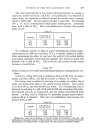
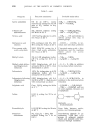
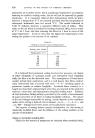
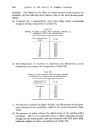
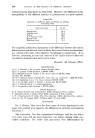
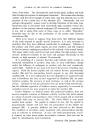
428 JOURNAL OF THE SOCIETY OF COSMETIC CHEMISTS permanent set is rather severe, but if a particular treatment is successful in inducing set stable to boiling water, the set will not be removed by gentler treatments. It is commonly believed that deformations which are intro- duced at a temperature T ø C are retained provided that the temperature of subsequent treatments does not exceed T ø C. The results indicated in Table II indicate, however, a somewhat different state of affairs. They relate to the set which is retained by heating stretched (40}/0) hair in water at T ø C for 1 hour, and then releasing the fibres for 1 hour in water at the same temperature. It can be seen that the higher the temperature of the setting the greater is the amount o[ set retained. Table II Setting of wool at various temperatures Setting and release Temperature (ø C) 70 8O 90 95 100 110 % Set 6.8 8.7 11.4 15.3 23-2 22-3 It is believed that permanent setting involves two processes, viz. fission of either disulphide or hydrogen bonds, and subsequent bond rebuilding while the fibre is in the deformed state. The consequences of bond fission usually include fibre contraction, and it is well known that fibres contract when unstretched hair is treated with such --S--S-- breaking agents as potassium cyanide or sodium bisulphite. Stretched fibres contract to a length less than their original length when they are steamed in the stretched state for a short time, and subsequently released in boiling water. Evidence of bond formation during setting is provided by the results of measurements of supercontraction of set fibres in boiling bisulphite solutions. The nature of the new linkages responsible for setting, clearly depends on the conditions under which setting is induced, but re-formed --S--S--, --C--S--C--, and --S--NH-- linkages have been shown to be particularly important. Two aspects of setting deserve special consideration, viz. the setting of chemically modified fibres, and the influence of the setting medium on the amount of set induced. Setting of chemically modified .fibres Values for the amount of permanent set obtained when stretched {40%)

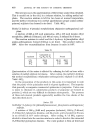
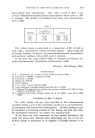
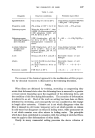
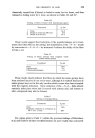
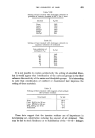
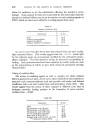
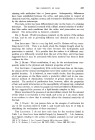
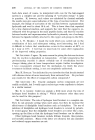
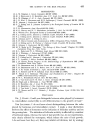
THE CHEMISTRY OF HAIR 429 chemically treated hair (Chinese) is boiled in water for two hours, and then released in boiling water for 1 hour, are shown in Tables III and IV. Table III Setting of fibres treated with hydrolysing agents Treatment 1. None 2. Boiled in water for 48 hours 3. Boiled in 0-1N HC1 % Set 14-5 6'3 14'7 These results suggest that hydrolysis of the peptide linkages as in treat- ment $ has little effect on the setting, but stabilisation of the --S--S-- bonds by conversion to --C--S--C-- by treatment 2 reduces the ability of the fibre to take a set. Table IV Setting of fibres treated with reagents which attack amino groups Treatment None Nitrous acid Difluoronitrobenzene % Set 14'5 --1-1 --1 '3 These results clearly indicate that fibres in which the amino groups have been rendered inactive do not set in water, although it is realised that loss of amino groups may not be the only reaction which occurs when hair is treated with the reagents indicated. Some oxidation of the --S--S-- links almost certainly takes place when hair is treated with nitrous acid, and nitroso or nitro compounds may also be formed. Table V Setting of esterified fibres Treatment None Hydrogen chloride in methanol at 50øC for 1 hour % Set 14'5 26.1 The values given in Table V confirm the previous findings of Blackburn et al, and Unilever (4) that esterified keratins set more readily than untreated
Purchased for the exclusive use of nofirst nolast (unknown)
From: SCC Media Library & Resource Center (library.scconline.org)