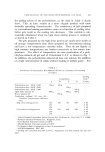
342 JOURNAL OF THE SOCIETY OF COSMETIC CHEMISTS In 1959 Stecker (5) reported that a synergistic mixture existed between 5,4•-dibromosalicylanilide and 3,5,4•-tribromosalicylanilide (Diaphene •*) when combined in the proper proportions. By a modified fresh calfskin technique he demonstrated the substantivity and anti- bacterial properties of the mixture (6). At about the same time Mattson (7) reported another similar syner- gistic mixture consisting of 3,5-dibromosalicylanilide (approximately 15%), 3,5,4•-tribromosalicylanilide (approximately 85%), and traces of a monobromosalicylanilide derivative. This mixture is referred to as ET-394'['. The fact that Stecker (6) noted that the brominated salicylanilides were not inactivated by the presence of various emulsifiers and surface active agents suggested the possibility of physical solubilization of ET-394. All attempts to prepare a 0.1% aqueous solution of ET-394 by the addition of various nonionic or anionic surface active agents were unsuccessful. Even the addition of 50% ethanol failed to dissolve ET-394. Attempts to add ET-394 as a solution in polyethylene glycol 600 monolaurate to various combinations of ethanol, surface active agents and water were also unsuccessful. Occasionally a chemical similar in structure to the material under investigation is capable of increasing the compound's solubility. Thus, the use of salicylanilide as a solubilizing agent was attempted, but without StlCCeSS. Recently Russell (8) reported the solubilization of Diaphene to the extent of 0.8% in a mixture of 4% nonionic surface active agent and either 40% detergent or potassium coconut oil soap. Bacteriological testing of these solutions showed activity equal to that of a similar solution containing hexachlorophene. Thus it appeared that the use of complexation or simple physical means would not work to enhance the solubility of ET-394 in water or in 50% ethanol at low surfactant level. On the other hand, it seemed likely that the brominated salicylanilides as their sodium, potassium or ammonium salts might exhibit improved water solubility. EXPI)•RIMENTAL Preparation of Salts Sodium ET-394 was the first salt to be prepared, and its preparation was accomplished in the following manner: Fifteen milliliters of a 10% * Diaphene is a registered trademark of the Stecker Chemicals, Inc., Ho-Ho-Kus, N.J. t Manufactured by The Dow Chemical Company, Midland, Mich.

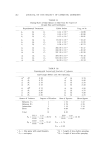
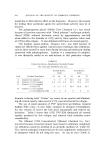
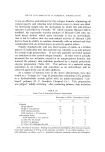
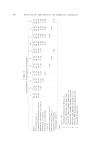
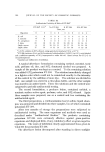
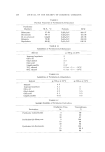
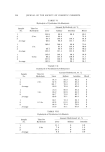
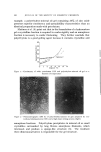
SOLUBLE BROMINATED SALICYLANILIDES 34:3 solution of sodium hydroxide in absolute ethanol was triturated for 30 minutes with 10 g. of ET-394 in a mortar at room temperature. The insoluble product produced was collected on a filter, dried, and recrys- tallized from hot 25% ethanol. The melting point was 300øC, and the salt (sodium ET-394) did not fluoresce under U.V. light. In a similar manner the sodium and potassium salt of the two major compo- nents of ET-394 were prepared. These are listed in Table I. The ammonium salts could not be prepared by the above method. Thus, ammonium ET-394 was prepared by shaking for one hour at room temperature a mixture of 2 g. of ET-394, 50 mi. of 50% ethanol and 50 TABLE I Salts of Brominated Salicylanilides Yield Calcd., % Found, Salicylanilide Salt % M.p. øC C H C H ET-394 Na 73 300 ET-394 K 90 300 ET-394 NH4 55 227-9 3,5,4•-tribromo Na 65 300 3,5,4•-tribromo K 63 300 3,5,4•-tribrorno NH4 71 232-4 3,5-dibromo Na 74 300 3,5-dibromo K 65 300 3,5-dibromo NH• 74 140-2 33 08 31 99 33 43 39 95 38 05 40 21 1.49 32.46 1.45 31.63 2.37 34.10 2.04 39.55 1.95 37.78 3.09 39.66 1.80 2.02 2.39 2.20 2.15 3.01 mi. of 28% ammonium hydroxide in a pressure bottle containing glass beads. After cooling of the mixture, the pressure bottle was opened. The mixture was warmed to remove the excess ammonia, filtered and cooled to precipitate the product. After collection on a filter and recrystallization from 25% ethanol, a 55% yield of ammonium ET-394 was obtained which fluoresced under U.V. light and melted at 227-9øC. The ammonium salts of the components of ET-394 were similarly pre- pared. Infrared Absorption Data As proof of salt formation, the infrared spectra of the various new compounds were compared with those of the parent molecules. 3,5,4CTribromosalicylanilide gave bands at 3525 for stretching OH, 1645, 1590, and 1540 for the amide group and 1175 cm.-• for the deforma- tion of the OH group. The higher amide bands and the presence of the stretching OH bands indicated that the parent molecule exists in the • form (9) [H-bonding between (NH) and (OH) with the carbonyl group
Purchased for the exclusive use of nofirst nolast (unknown)
From: SCC Media Library & Resource Center (library.scconline.org)