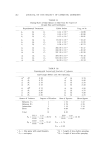
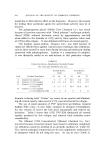
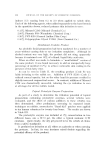
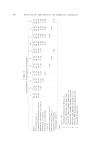
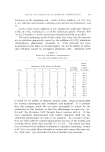
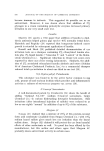
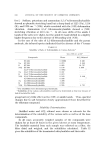
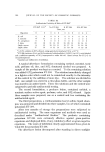
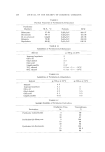
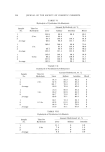
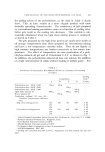
346 JOURNAL OF THE SOCIETY OF COSMETIC CHEMISTS TABLE III Antibacterial Activity of Salts o[ ET-394 a ET-394 •' G-11 ø Na ET-394 K ET-394 NH4 ET-39t Time, mo. Organism 0 E. coli 0 A. faecalis 6 c Ps. aeruginosa 0 S. lutea 21 Staph. aureus 8 Staph. albus 17 0 0 3 6 0 3 6 0 3 6 0 0 0 0 0 0 0 0 0 0 11 3 2 3 3 6 3 2 2 3 0 0 0 0 0 0 0 0 0 0 18 11 14 12 15 20 13 13 14 11 12 15 16 11 12 17 15 11 12 13 13 8 11 14 11 19 16 8 13 13 a A 0.5% solution in 50% ethanol, using agar plates incubated 72 hr. at 37øC. 0 ET-394 (mixture of tri- and di-brominated salicylanilides) (0.025%) in 0.5% cetyl alcohol aud a sufficient quantity of 70% isopropanol to make 100 mi. Same solvent for 0.1% G-11 (hexachlorophene). c Numbers are millimeters of inhibition. A typical aftershave formulation containing sorbitol, menthol, boric acid, perfume oil, dye, and 50% denatured alcohol was prepared. A sample of the product was kept as a control. To the remaining solution was added 0.2% potassium ET-394 The solution immediately changed to a lighter color which could not be rematched exactly to the intensity of the control by the addition of more dye. The solution was divided in half one sample was stored in a clear glass bottle, and the other sample was stored in an amber bottle. These two solutions and the control were subjected to periodic antibacterial testing. The second formulation, a preshave lotion, contained sorbitol, a nonionic surface active agent, perfume, color, and 50% ethanol. Again three samples were prepared, one as a control and two containing the antibacterial agent. The third preparation, a triethanolamine lauryl sulfate liquid sham- poo, was prepared and divided into three samples, two of which contained potassium ET-394. After two months of storage the preparations were subjected to antibacterial testing. The same organisms and methods were used as described under "Antibacterial Studies." The products containing potassium ET-394 were extremely effective against gram-positive organisms and displayed little, if any, inhibitory effect on gram-negative organisms. The zones of inhibition closely approximated those given in Table III for potassium ET-394. The aftershave lotion decomposed after standing in direct sunlight

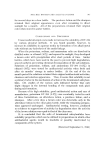
SOLUBLE BROMINATED SALICYLANILIDES 347 for several days in a clear bottle. The preshave lotion and the shampoo retained their original appearances even after remaining in direct sunlight for a month. All of the preparations retained their original color when stored in amber bottles. CONCLUSIONS AND DISCUSSION Unsuccessful attempts were made to increase the solubility of ET-394 by various physical methods. It was found possible, however, to increase its solubility in aqueous media by formation of its alkali metal salts without any hydrolysis of the amide linkage. When the potassium, sodium, and ammonium salts are dissolved in distilled water or ethanol (50%) and exposed to sunlight, they developed a brown color with precipitation after short periods of time. Amber bottles, which have been used in the past to prevent light degradation, proved useful in preventing chemical decomposition of the salt solutions. Solutions of potassium, sodium, and ammonium ET-394 (0.5%) in ethanol (50%) were tested for antibacterial activity when fresh and after six months' storage in amber bottles. At the end of the six month period the solutions retained their original antibacterial activities, clearness and colorless appearance. Thus, it seems that solubility is not a primary factor in the mechanism of action of the brominated salicylani- lides. I.R. studies of the various salts indicated further that only slight changes in the internal bonding of the compounds took place during salt formation. Because of its high solubility, good antibacterial action and ease of manufacture, potassium ET-394 (0.2%) was eventually tested in each of three formulations, an aftershave lotion, a preshave lotion, and a shampoo. After a few days a brown color was detectable only in the aftershave lotion in the clear glass bottle, while the remaining prepara- tions appeared unchanged. Antibacterial testing, however, produced no evidence to support loss of activity by degradation since the activity of the brown solution was equal to that of the clear ones. It is concluded that the salts of brominated salicylanilides have solubility properties which can be utilized in preparations in which other antibacterial agents would be insoluble or possibly inactivated by components of the system. (Received September 9, 1964)
Purchased for the exclusive use of nofirst nolast (unknown)
From: SCC Media Library & Resource Center (library.scconline.org)