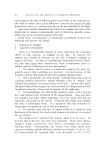
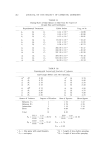
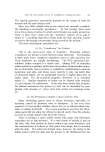
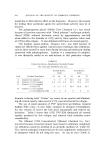
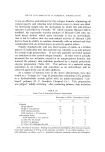
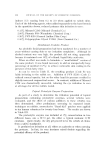
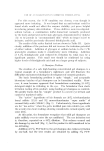
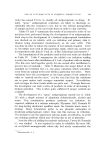
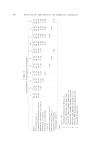
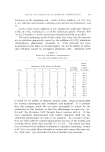
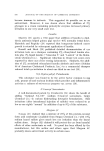
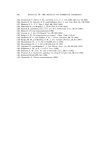
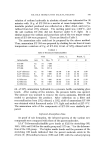
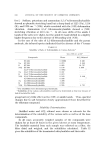
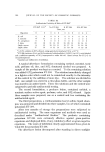
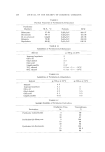
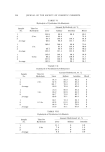
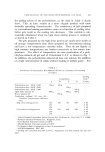
35O JOURNAL OF THE SOCIETY OF COSMETIC CHEMISTS TABLE I Physical Properties of Pyridoxine-3,4-Diacylates Pyridoxine Diacylate M.P., øC Formula M.W. Dibutyrate 57-58 C16H230,•N 309.37 Dioctanoate 69-71 Cs4H39OsN 421.58 Di-iso-octanoate Liquid C24H•90•N 421.58 Dilaurate 79-80 C•H•aO.•N 533.80 Dipalmitate 88-89 C40H7•Or, N 646.01 TABLE II Solubilities of Pyridoxine-3,4-dioctanoate Solvent g./100 g. at 25øC Isopropyl myristate 2 Olive oil 1 Oleyl alcohol 3.5 Oleic acid 5 Liquid paraffin 0.07 70% ethanol 0.3 at -- 5 •-• -- 10øC 60% ethanol 0.1 at - 5 •-• - 10 C TABLE II I Solubilities of Pyridoxine-3,4-dipalmitate Solvent g./100 g. at 25øC g./100 g. at 75øC Ethanol 0.5 Isopropyl Inyristate 0.1 3 Olive oil 0.1 5 Oleyl alcohol 0.2 5.5 Oleic acid 0.1 5.5 Liquid paraffin 0.01 0.5 TABLE IV Sunlight Stability of Pyridoxine Derivatives Derivatives Irradiation Time, Transmittanee, hr. % Pyridoxinc hydrochloride Pyridoxine,B,4-dibutyrate Pyridoxine-3,4-dioctanoate 0 99 15 92 30 87 0 100 15 99 30 98 0 100 15 99.5 30 98

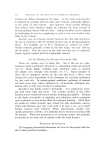
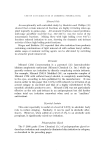
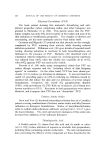
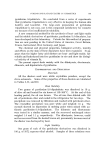
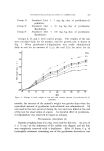
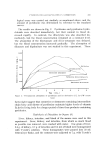
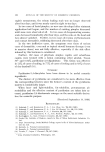
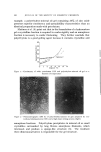
PYRIDOXINE-3,4-DIACYLATES IN COSMETICS 351 pyridoxine tripalmitate. He concluded from a series of experiments that pyridoxine tripalmitate is very effective in keeping the human skin healthy and beautiful. The large-scale preparation of pyridoxine tripalmitate is not easy, nor is this compound satisfactory for cosmetic use because of its insufficient fat-solubility. A new commercial method for the synthesis of heat- and light-stable and fat-soluble derivatives of pyridoxine, pyridoxine-3,4-diacylates, has been developed in this laboratory. Patents for this method of prepara- tion are now pending in the United States of America, Great Britain, France, Switzerland, West Germany, and Japan. The chemical and physical properties, biological activity, toxicity and effects on the skin of these diacylates have been examined. It ap- pears that the higher fatty acid diesters are heat- and light-stable, fat- soluble and hydrolyzed into free pyridoxine in vivo and show the biologi- cal activity of vitamin B6. The present report deals mainly with the dibutyrate, dioctanoate, dilaurate, and dipalmitate of pyridoxine. EXPERIMENTAL AND DISCUSSION Materials All the diesters used were white crystalline powders, except the di-iso-octanoate. Some of the properties of these diesters are tabulated in Tables I, II, and III. Heat Stability Two grams of pyridoxine-3,4-dipalmitate was dissolved in 10 g. of olive oil and heated for six hours at 150-160øC. At the end of this heating period, the oil was brown. The oil was then diluted with 100 ml. of petroleum ether and cooled in the refrigerator for two days. The precipitate was removed by filtration and washed with petroleum ether. The crystalline precipitate was pure white and weighed 1.6 g. The crystals showed no depression in melting point when mixed with au- thentic pyridoxine-3,4-dipalmitate. The dilaurate and dioctanoate were tested in a similar manner, and the recovered unchanged esters weighed 1.4 and 1.1 g. respectively. The dibutyrate, however, could not be recovered from the heated brown oil, presumably because most of the diester was destroyed by heat. Light Stability One gram of each of the pyridoxine derivatives was dissolved in 100 g. of 50% aqueous ethyl alcohol. Samples of these solutions were
Purchased for the exclusive use of nofirst nolast (unknown)
From: SCC Media Library & Resource Center (library.scconline.org)