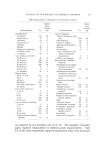
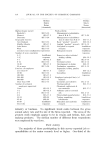
568 JOURNAL OF THE SOCIETY OF COSMETIC CHEMISTS The Aspergillus tamarri series is not widely distributed, nor it is particularly common. It has been isolated from soil and from decaying organic material. It has no pathogenicity and may be regarded only as a saprophyte. The only species isolated belonging to this series was Aspergillus terricola var. americana. Aspergillus versicolor var. glauca was isolated from human skin show- ing "ringworm," but pathogenicity was not proved experimentally (5). It is often found upon dried salted lean beef, thus showing its ability to grow upon meat products. It has been isolated from other, "non- meaty" places, such as bread, cereals, old cheese, rubber, and paraffins. These molds are widely distributed. SUMMARY 1. The mold flora of the scalps of 100 people has been investigated. 2. From 55 of these people, a total of 90 molds were isolated by culture and were identified according to monographs found in the literature. 3. The 90 molds were represented by 31 species. 4. The three most prevalent molds were Penicillium notatum, /1 Itemaria senecionis, and Penicillium brevi-compactum. 5. Four of the 31 molds isolated are known to be pathogenic to man. The rest are plant saprophytes or parasites as well, responsible for the decomposition of organic materials. 6. There is no evidence in the literature to show that any of the molds isolated may cause any specific pathological condition of the scalp. 7. This survey shows that the human scalp harbors molds in great abundance. (Received October 10, 1966) REFERENCES (1) Roia, F. C., VanderWyk, R. W., and Beal, J. A., The human scalp as a habitat for yeasts, J. Soc. Cosmetic Chemists, 14, 81 (1963). (2) Beal, J. A., Isolation and classification of aerobic bacteria from the human scalp. Master of Science Thesis, Massachusetts College of Pharmacy, 1962. (3) Epstein, J. M., The isolation and identification of fecal organisms frmn the human scalp. Master of Science Thesis, Massachusetts College of Pharmacy, 1963. (4) Delldorf, G., Fungi and Fungus Diseases, Charles C Thomas, Springfield, Ill., 1963. (5) Raper, K. B., and Thom, C., A Manual of Aspergilli, Williams and Wilkins, Baltimore, Md., 1945.

Book Reviews THE CHEMICAL FORMULARY, VOLUME XIII, edited by H. Bennett. Chem- ical Publishing Co., Inc., New York. 1967. 447 pages, indexed. Price $8. The 13th edition of the now familiar series of chemical formulary brings countless new formulas in sixteen broad areas to the chemical and ama- teur formulator. The first chapter again presents the well-known basic principles for compounding the for- mulations and is a fitting introduction for the volume, as well as a source of useful recipes. While several of the topics found in volume XII are in- cluded in volume XIII, none of the formulas are duplicated, and a large number of new fields are surveyed as well. The formulations are for the most part grouped under appropriate sub- ject headings, making it easy to browse through and compare. How- ever, industrial disinfectant cleaners are misplaced in Chapter IV, "Cos- metics and Drugs," and should right- fully be in Chapter XIV, "Soaps and Cleaners." Hard surface disinfec- tants are not drugs. Chapter V, "Emulsions," contains one formula for a self-polishing floor wax which should be included in Chapter XI, 569 "Polish," although admittedly it is an emulsion. Chapter XVI, "Miscellane- ous," includes a number of unrelated items. Fortunately, the index is complete and fairly accurate and di- rects one to the proper pages. Especially helpful are the alphabet- ical lists of chemicals and suppliers, which make it easy to locate the source of raw materials. The writer agrees with the editors of the volume that trade names for materials should be used to afford as many meaningful formulas as possible, but a description of the products should also be in- cluded so that a formula can be eval- uated. There is no way of knowing, for example, whether a material is an active ingredient, a filler, a preserva- tive, or an activator unless one is al- ready familiar with it. Several for- mulas are simply composed of a dozen specialty items giving no clue to their nature. As far as could be deter- mined, only one material, Detergicide (page 121), is not listed among the chemicals. Most of the chapters are well writ- ten, with both formulas and com- pounding procedure spelled out. Chapter XIII, "Rubber, Plastics, Waxes," is one exception--Kith for- mula upon formula and never a manu-
Purchased for the exclusive use of nofirst nolast (unknown)
From: SCC Media Library & Resource Center (library.scconline.org)