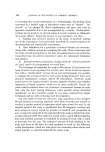
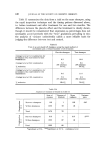
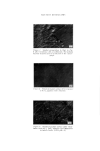
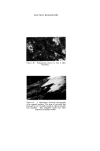
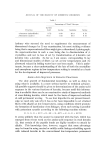
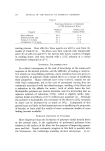
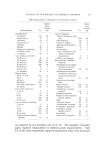
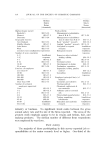
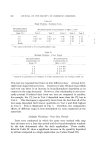
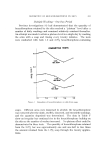
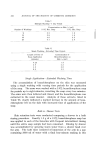
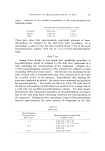
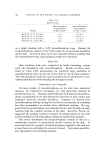
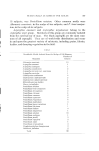
5O8 JOURNAL OF THE SOCIETY OF COSMETIC CHEMISTS integrity which compelled so quixotic a rejection of riches will, I hope, excuse my devoting so much of this address to those friends of earlier days. When the first of the cold permanent waving processes was invented, knowledge of the constitution and reactivity of keratin was still very primitive. It could be summarized in the statement that fibers like wool and hair consist of long, folded polypeptide chains with salt and cystinc linkages between them. During the past 35 years, however, there have been great advances in understanding, based on the use of new techniques such as electron microscopy and chromatographic methods of amino-acid analysis, but without any fundamental changes in the methods of permanent waving. These are still based on re- duction, followed by oxidation, and it is important to inquire why the new knowledge has found so little industrial application. For this purpose, different developments will be considered in turn. AMINO-ACID ANALYSIS The first complete amino-acid analyses of keratin became available in 1955 (1), but the knowledge was not as useful as was once expected, because earlier evidence that keratin is not homogeneous was reinforced by the results of electron microscope studies. The latter revealed the existence of ordered (crystalline) micro fibrils embedded in a disordered (amorphous) matrix, and during the past decade much effort has been given to the fractionation of keratin, identification of the histological origin of the fractions, and to their amino-acid analysis. The most usual method of experiment has been to oxidize cystinc cross linkages into cysteic acid side chains, to extract the oxidized keratin with dilute ammonia, and then fractionally precipitate the extracted proteins with acid. There is evidence to link the two main fractions with micro fibrils and matrix, and some of the differences in composition are given in Table I (2). The fact that the two fractions differ so greatly in content of cystine, lysine, and serine, all of which are now known to be involved in high- temperature setting reactions, is one of the reasons why early X-ray studies of fibers set at high temperatures showed such a difference in rate of response of the ordered and disordered regions. Because of this difference in rate of response, and also of rate of loss of set during relaxation in steam or boiling water, it became clear also that no exact understanding of the chemical mechanism of setting with different re- agents could be obtained from dimensional changes alone. It was

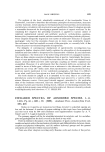
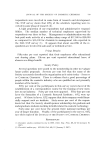
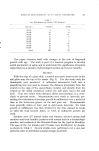
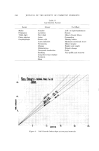
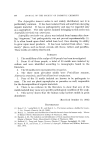
JOURNAl. OF THE SOCIETY OF COSMETIC CHEMISTS 509 Table I Percentage of Total Nitrogen Cysteic Fraction Acid Lysine Arginine Serine a-keratose (microfibrils) 3.72 4.60 20.8 6.70 •-keratose (matrix) 14.5 1.03 19.0 9.70 Astbury who stressed the need to supplement the measurement of dimensional changes by X-ray examination, his most striking evidence being that a supercontracted fiber might give a disordered E-photograph, the supercontraction in such a case being due to disorientation of E- crystallites and not to loss of set by transformation of •-keratin (set keratin) into a-keratin. So far as I am aware, corresponding X-ray and dimensional studies of fibers (a) set at low temperatures and (b) afterward relaxed in boiling water have not been made. This is unfor- tunate, because a clear understanding of the fate of both the crystalline and amorphous regions in low-temperature setting is essential as a basis for the development of improved processes. AMXNO-AcxD SEQUENCE IN KERA. TIN FRACTIONS The slow growth of fundamental knowledge, as well as delay in using what is available, is a more serious barrier to technical advance. All possible support should be given to determinations of the amino-acid sequence in the various fractions of keratin, because until this informa- tion is available there can be no constructive study of improved methods of cross-linking keratin, which must be the basis of improved methods of cold permanent waving. To see how imperfect is our present knowl- edge we need only ask why it has so far been impossible to set strained fibers with alkalies at low temperatures, using conditions which promote the formation of lanthionine cross linkages, when such setting is possible with potassium cyanide according to the following reaction scheme: R--S• R d- KCN --• R--SK d- R--SCN --• R--S--R d- KCNS It seems unlikely that the answer is connected with the fact, which has emerged from recent work on the amino-acid sequence in wool keratin (3), that certain of the peptide bonds are highly sensitive to attack by alkalis. This knowledge does, however, suggest that some advantage may be found in using neutral or mildly acidic linkage-rebuilding agents with reduced keratin in the conventional low-temperature permanent
Purchased for the exclusive use of nofirst nolast (unknown)
From: SCC Media Library & Resource Center (library.scconline.org)