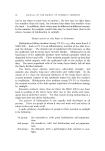
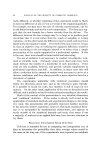
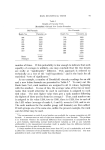
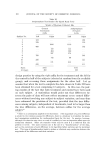
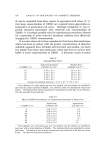
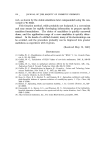
102 JOURNAL OF THE SOCIETY OF COSMETIC CHEMISTS Table IV Ranking of Antiperspirant Test Data-Signed Rank Test Subject Mg Moisture Control- No. Control Treated Treated Rank 1 251 201 %.50 %. 4 2 258 150 %.108 %. 5.5 3 1006 1116 -- 110 -- 7 4 669 702 --33 -- 2 5 150 131 %.19 %. 1 6 484 350 %.134 %.10 7 397 274 %.123 %. 9 8 783 503 %..289 %.12 9 142 99 %.43 d- 3 10 380 151 %..229 %.11 11 721 613 %..108 %- 5.5 12 522 411 %.ill q- 8 Sums 5763 4701 + 1253 • Averages 480 390 + 104 Sum of (%.) ranks = %.69 Sum of (--)ranks = --9 T=9 Algebraic sum. "very moist." As before, the number of ties encountered should not exceed about 10% of the total number of differences in the group. If a difference of zero is obtained, this set of data (subject) is not ranked, but is eliminated from consideration, and the number of pairs then con- sidered to be one less than the actual number used. MULTIPLE RANK TEST FOR PAIRED DATA This procedure, as well as a related one for unpaired data, is described in reference 1. The application is to a situation where more than two treatments are used and the experimenter wishes to determine: whether he can claim that a real difference exists between the means of any pair of subjects if so, which of the differences are involved and the probability of an incorrect conclusion in each case. As discussed briefly above, both of the preceding tests operate by allowing the determination of the probability that an observed difference between means or a mean difference has occurred purely by chance. If this probability is statistically small, the experimenter may feel that the

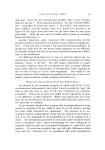
EASY STATISTICAL TESTS 103 explanation involving chance is quite unlikely, and he then has the option of claiming that a real difference exists. The fact that he decides to make such a claim obviously does not rule out the possibility that there really is no difference. In each of the first two tests, the probabili- ties given in the tables are based upon the assumption that a single com- parison only is to be made. Suppose, however, that 100 such pairs of observed differences are being tested and that, unknown to the investi- gator, none of them is actually real. In such a ease, there will neverthe- less be a number of instances to which the test will assign a low prob- ability. If the experimenter decides to claim that those differences assigned a low probability are real, he will be wrong. Another way of stating this is to say that when more than one pair of averages is being compared by means of a statistical test, the true probability of each difference will be greater than that found, and the experimenter's risk in making a decision to take some action will be correspondingly increased. The Multiple Rank Test is designed to handle problems involving more than one difference between means, and it does so by requiring that the differences be larger than would otherwise be the case before a given probability can be claimed. The size of the difference required for a certain probability of the null hypothesis will increase as the number of treatments among which all pairs are to be compared increases. Suppose that, as in the previous example, antiperspirants are being tested, but that there are four materials involved, and that it has already been established that each is effective by comparing it with a control as described above. It is now of interest to learn whether any of the four materials is more effective than any other. This time, a decision is made to utilize the skin of the subject's backs, so that all four materials may be applied to each of the subjects in the test, thus giving a "paired" pro- cedure analogous to the two-sample paired test. Here, although the experimenter may feel that there is a difference between the action of an antiperspirant in an axilla compared to the use of the same material on the skin of a subject's back, it is assumed that he believes the relative effectiveness of the four materials will not be changed by the use of backs rather than axillae. In carrying out this experiment, it is advisable to observe a well- established experimental design principle to avoid any likelihood of a systematic effect related to location on the back (3). This is done by assigning each treatment to a randomly-selected spot on each back, with a different random selection for each subject. As before, some measure of the quantity of moisture generated on each site, under standard condi-
Purchased for the exclusive use of nofirst nolast (unknown)
From: SCC Media Library & Resource Center (library.scconline.org)