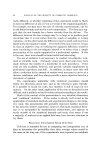
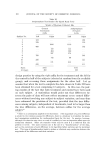
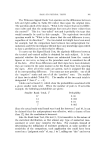
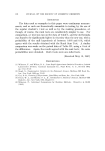
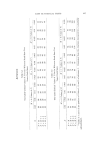
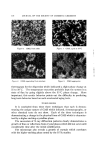
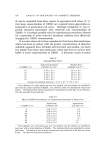
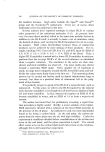
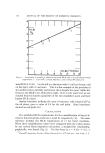
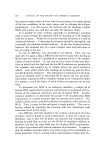
104 JOURNAL OF THE SOCIETY OF COSMETIC CHEMISTS Table V Results of Multiple Antiperspirant Test Weight Gain, Mg Subject Formula Formula Formula Formula No. A B C D 1 250 304 177 408 2 147 329 98 573 3 362 487 85 319 4 103 675 299 274 5 201 278 311 585 6 177 190 112 612 7 96 453 136 899 Sums 1336 2716 1218 3670 Averages 191 388 174 524 Table VI Ranking of Antipcrspirant Test Data Multiple Rank Test Sub- ject For•nula Formula Formula Formula No. A Rank B Rank C Rank D Rank 1 250 2 304 3 177 1 408 4 2 147 2 329 3 98 1 573 4 3 362 2 487 3 85 1 319 4 4 103 i 675 4 299 2 274 3 5 201 i 278 2 311 3 585 4 6 177 2 190 3 112 I 612 4 7 96 i 453 3 136 2 899 4 Rank Sums 11 21 11 27 Rank differences (ignoring signs): A -- B = 10 (A is less than B) A -- C = 0 (A and C are the same ) A -- D = 16 (A is less than D) B -- C = 10 (C is less than B) B -- D = 6 (B is less than D) C -- D = 16 (C is less than D) tions, is obtained. Table V shows the results of the test, using seven subjects. .Each of the four sets of data is now ranked within each subject-- that is, for each subject the four different formulations are ranked. In case of ties, the same procedure as described previously is used. After ranking the data, the column of seven rank numbers for each of the four materials is added (Table VI). Differences between every possible

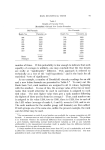
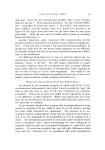
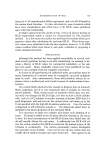
EASY STATISTICAL TESTS 105 pair of rank totals (there are six such differences) are now obtained. These differences are shown below. For four treatments and seven subjects a table (1), two-tailed,* shows the following probabilities: Difference Between Probability 2 Rank Totals 0.10 11.1 0.05 12.4 0.01 15.0 In Table VI, two differences greater than 11.1 were found viz., that for .4 rs. D and for C rs. D. These were both 16. Sixteen exceeds the tabular difference even at the 0.01 probability point. It can therefore be claimed that treatments A and C are each more effective than D, with a chance of less than 1 •o of being wrong. Reference to Table VI shows that there is a possibility that formulas A rs. B and B rs. C also produce real differences, and that the experi- mental errors were just too great to give a sufficiently large rank differ- ence to lead to a probability of 0.10 or less. If it is felt that this may be the case, a new experiment using A, B and C only, possibly with more subjects than before, might be run. SUMMARY In using significance tests, it should be noted that the magnitude of the probability required to "disprove" the null hypothesis is a matter for the experimenter himself to decide. In some instances, when the conse- quences of an incorrect conclusion are minor, such as the necessity for repeating some test procedure, a relatively high probability value may be acceptable. In fact, it may often be advantageous to use a high probability such as 0.10 or 0.05 when potential new products are being screened, to minimize the possibility of discarding a potentially good material. On the other hand, if the experimenter envisions serious conse- quences for claiming a real difference when it actually does not exist, he may feel it necessary to withhold a decision unless a relatively low probability is obtained. In cases of doubt, of course, it would be ad- visable to repeat an experiment. For additional information the in- terested reader may wish to consult references 4 and 5. * There is no one-tailed test for multiple treatments, since the question must always be "is there any real difference between any of several pairs of rank totals." A one-tailed test would not apply.
Purchased for the exclusive use of nofirst nolast (unknown)
From: SCC Media Library & Resource Center (library.scconline.org)