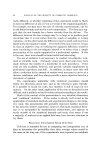
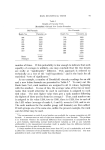
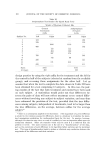
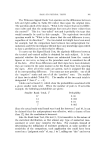
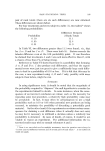
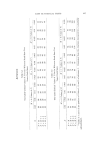
106 JOURNAL OF THE SOCIETY OF COSMETIC CHEMISTS ADDENDUM The data used as examples in this paper were continuous measure- ments, and as such are theoretically amenable to testing by the use of the regular student's t test as well as by the ranking procedures, al- though, of course, the rank tests are considerably simpler to use. For comparison, a t test was run on the data of Table I, and the old formula was found to be significantly higher in viscosity than the new one, with a probability of the null hypothesis of between 0.005 and 0.01, which agrees with the results obtained with the Rank Sum Test. A similar comparison was made on the paired data of Table III, using a t test of the differences. Again, the results agreed with the rank tests the same probabilities were obtained. Both t tests were one-tailed tests. (Received May 18, 1967) REFERENCES (1) Wileoxon, F., aud Wilcox, R. A., Some Rapid Approximate Statistical Procedures, Lederle Laboratories Division, American Cyanamid Co., Pearl River, N.Y., Revised 1964, pp. 7-12, 20-27. (2) Siegel, S., Nonparametric Statistics for the Behaz•ioral Sciences, McGraw-Hill Book Co., Inc., New York, 1956, pp. 75-8.3. (3) Cox, D. R., Planning of Experiments, John Wiley and Sons, Inc., New York, 1958. (4) Dixon, W. J., and Massey, F. J., Jr., Introduction to Statistical Analysis, McGraw-Hill Book Co., Inc., New York, 1951, Chapter 17. (5) Wilcoxon, F., Individual Comparisons by Ranking Methods. Biometrics 1, 80-83 (1945).

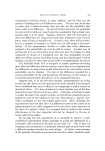
EASY STATISTICAL TESTS 107 +++ 11 1I II II +++ II II II
Purchased for the exclusive use of nofirst nolast (unknown)
From: SCC Media Library & Resource Center (library.scconline.org)