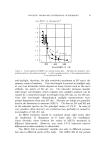
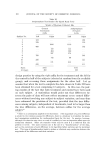
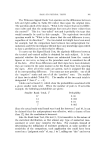
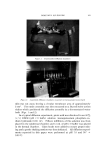
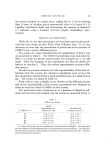
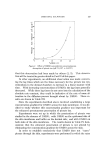
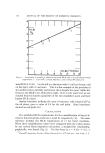
DETERMINATION OF HLB 133 being the O/W emulsification HLB requirement, and x the HLB found by the carbon black titration. To date, all relatively pure chemicals which have been standardized and which have O/W HLB values published agree with this relationship. It might appear from the graph of Fig. 2 that oil phases having an HLB requirement below 8 cannot be characterized by this titration method. In a few cases, the author has performed titrations which gave negative values after calculating the end point HLB. When these nega- tive values were substituted into the line equation, however, O/W HLB values resulted which were below 8, and quite verifiable by preparing a stable emulsion therewith. APPLICATIONS Although this method has been applied successfully in several tech- nical service problems having to do with emulsifying, no attempt to de- velop a library of HLB values for commercial emulsifiers, or for oils, has been made. Many emulsifier values have been published by sup- pliers or are available from the suppliers concerned. As is true in all experimental or analytical work, precautions must be taken, limitations of a method must be recognized, and good judgment must be used. Also, unfortunately, there will probably always be in- stances when a method just won't work because of undetermined inter- ferences. The carbon black selected is fine enough to disperse into an intensely black suspension, but it is very important that it actually be well dis- persed initially. With certain types of nonionics which may not wet- out well, even though the HLB is high, it is best to start a fresh cylinder with 1 ml of a 10% solution of another nonionic of known HLB that is a good dispersant, add and wet-out the carbon black, and make up to the 10 ml specified with the high-HLB solution under test. Once the carbon is dispersed, it will ordinarily remain so. The dispersant added must be included in the final calculation of the end point HLB. It is necessary to shake the cylinder just before each addition of ti- trant. If titrant is added to the oil phase directly, floating at the top as it does, the local concentration of low-HLB titrant thus added into the oil will usually distort the end point. A sufficiently low HLB will oil- wet the carbon whether this HLB is reached in the normal course of the titration or accidentally. The carbon presumably cannot distinguish the intention of the chemist. Once wet by the oil, the carbon does not readily divest itself to become once more water-wet. This appears to be

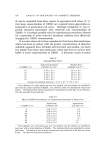
134 JOURNAL OF THE SOCIETY OF COSMETIC CHEMISTS the greatest single source of error both by preventing a thorough mixing of the two emulsifiers in the water phase, and by coloring the oil-layer prematurely. For this reason, the method calls for titrating a higher HLB with a lower one, and does not offer the alternate choice. It is possible in some systems, especially in preliminary screening runs, to pass through the optimum HLB for forming an O/W emulsion with the oil phase. While this is not the titration end point, it is still an analytical nuisance. Continuing the titration should be attempted, and eventually the emulsion should break up. In the case of lauryl alcohol, however, the emulsion may be a quite compact mass and form more or less of a plug at the top. In case of difficulty, two alternatives are offered. First, one can start all over again, using a different substrate to begin with, having an HLB below the value of 14 published as optimum for the O/W emulsifi- cation of lauryl alcohol. Or, one can set up a series of step-wise titra- tions in which both the high and the low HLB solutions are premixed in the cylinders and brought up to volume before the lauryl alcohol is added. Now, observations after shaking can be lined up, and the titra- tion HLB closely estimated. This alternative is reminiscent of the mak- ing of an emulsion series to determine HLB values, but it is far faster. Each phase separation will be complete enough to be evaluated in under five minutes, even if the entire 10 ml of oil does not separate out in that time. To determine the HLB of an unknown emulsifier, a simple oil of known HLB requirement is selected, and titration is performed with so- lutions of the unknown surfactant and one of known HLB. Another common problem is to determine the proper O/W emulsification HLB requirement of a mixed oil phase that has already been selected. The author usually starts a trial with solutions of emulsifiers with extremes of HLB. Thus, a range for the end point is found quickly. This can be further refined by repeating the titration with two surfactants both somewhat closer to this range. One difficulty with this method is the evident requirement that the oil phase must be liquid at room temperature, so that the carbon can distribute, and so that the oil phase can separate out homogeneously. Bearing in mind that not only are the HLB's of emulsifiers additive in mixtures, but that the same holds true for oil-phase HLB requirements, the author has worked with toluene solutions of petrolatum. It appears that the additive function works very well so long as the petrolatum re- mains dissolved that is, as long as the concentration is below that of a
Purchased for the exclusive use of nofirst nolast (unknown)
From: SCC Media Library & Resource Center (library.scconline.org)