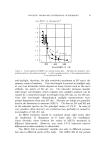
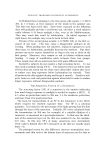
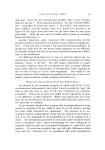
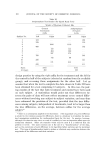
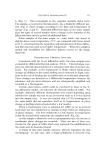
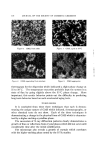
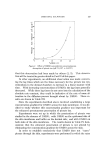
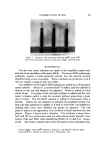
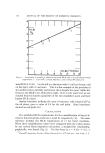
BIOLOGIC PROBLEMS CONCERNING SUNSCREENS 87 tog MED in Wsec/cm 2 -4 -3 -2 -1 0 +1 - 3 300 400 500 wavelength in nm Figure 1. Action spectra for MED's on normal human skin. The lines are tentative inter- polations between the points measured. 1, early vascular reactions 2, for unpigmented skins ,3, for pigmented skins and daylight, therefore, the skin sensitivity maximum at 297 nm is the primary cause of sunburn. This wavelength is present in sunlight only at very low intensities which depend on many factors such as the sun's altitude, the purity of the air, etc. The intensity increases sharply with longer wavelengths, which explains why sunlight sunburn can be caused by a somewhat longer wavelength than 297 nm, eg, by 306 rim. Near this wavelength climatological sunlight measurements have greater importance than near 297 rim. Mercury arc lamps are generally used in the laboratory to measure MED's. The lines at 297 and 302 nm in the emission spectra are the principal causes of UV-E. In cases of very sensitive skins mercury arc erythemas may partially be caused by wavelengths of 248-265 rim. An MED-erythema should be examined about eight hours after the irradiation. It disappears 12-15 hours after the irradiation. Great diversity exists between the values of MED's measured in different laboratories. However, any weak UV-E indicates relative differences in skin reactivity to ultraviolet. The MED 300 is extremely variable not only in different persons but also in different parts of the body. The MED 300 of one person

88 JOURNAL OF THE SOCIETY OF COSMETIC CHEMISTS can be ten times or more that of another the face may be eight times less sensitive than the back, the forearm four times less sensitive than the back. In addition, these values may be different in different seasons. In the summer, for example, sensitivities may be much lower than in the winter, because of habituation to sunlight. HABITUATION OF THE SKIN TO SUNBURN Habituation follows medium strong UV-E's, e.g., after more than 2-3 MED 300. Such a UV-E is an inflammatory reaction of the skin to re- pair the damage. The mitotic rate of epidermal cells increases, so that the epidermis and its horny layer become thicker. Melanocytes in the basal layer of the epidermis produce more melanin granules which are deposited in the basal cells. These melanin granules break up into finer particles which migrate with the epidermal cells to the surface of the skin. The most superficial cells of the horny layer finally fall off with the finely divided melanin. The horny layer absorbs short-wave ultraviolet strongly but melanin also absorbs long-wave ultraviolet and visible light. In the course of 4-7 days the increased thickness of the horny layer and in- creased melanin content of the epidermis makes the skin less sensitive to irradiation. Habituation after medium strong UV-E's is, therefore, the natural reaction of the skin against repetition of irradiation damage by sunlight. Excessive sunburn (more than six times the MED 300 in one dose) leads to peeling of the horny layer after one or two weeks and conse- quent loss of protective power. For that reason strong sunburning in a single dose does not add to habituation. The process of habituation is not equally well developed in all persons. There are people in whom it does not work well and others in whom it does not work at all. A quite arbitrary classification of people in their reaction to sunlight is the following: 1st group: 2nd group: 3rd group: the insensitives, with good habituation and pigmenta- tion the sensitives, with bad habituation and no pigmenta-. tion the diseased, with a pathological skin reaction to sun- light.
Purchased for the exclusive use of nofirst nolast (unknown)
From: SCC Media Library & Resource Center (library.scconline.org)