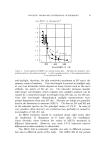
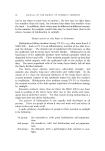
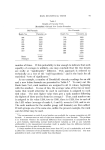
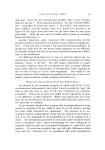
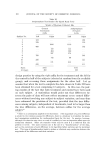
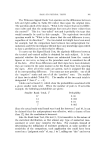
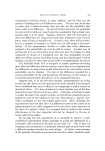
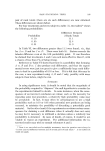
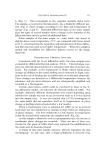
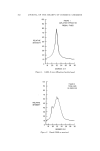
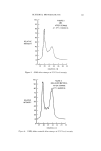
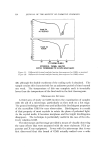
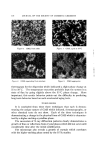
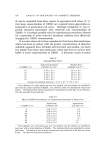
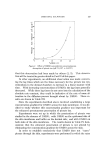
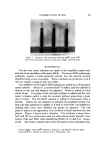
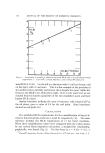
DIMETHYL SULFOXIDE 125 x :• 20 o ) . 0 , 0 20 % DMSO (v/v) Figure 3. Effect of DMSO concentration on percutaneous absorption of pierate ion (pH 7.0, 30 ø 4- 0.05øC) that this observation had been made by others (2, 3). This observa- tion will be treated in greater detail in Part II of this paper. In other experiments, an additional observation was made concern- ing the lag times which are the times necessary for the pierate ion con- centrations in the dermal chambers to increase in a linear manner with time. With increasing concentrations of DMSO, the lag times generally decreased. While these lag times do not enter into the calculation of the absolute rate constant, they could be indicative of the rate of some al- teration in the diffusion process brought about by DMSO. These re- suits are shown in Table III. Since the experiments described above involved establishing a large concentration gradient for DMSO across the skin membrane, it was de- cided to study whether this concentration gradient was important for the enhanced percutaneous penetration of pierate ion. Experiments were set up in which the penetration of pierate was studied in the absence of DMSO with DMSO on the epidermal side of the skin membrane and buffer on the dermal side and with DMSO on both sides of the skin membrane. The results shown in Table IV dem- onstrate that the enhanced penetration of pierate is not altered by eliminating the concentration gradient for DMSO across the skin. In order to establish conclusively that DMSO does not "carry" pierate through the skin, experiments were performed in which the rates

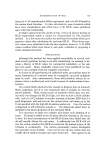
126 JOURNAL OF THE SOCIETY OF COSMETIC CHEMISTS Table IV Mechanistic Studies of DMSO as a Percutaneous Carrier • Expt. Epidermal Chamber Contents Dermal Chamber Contents Absolute l•ate Constant (cm hr -1) 1 Buffer b and picrate (5.93 X Buffer b 6.89 X 10 -4 10 -2M) 2 80% DMSO in buffer • and Buffer • 14.6 X 10 -4 pierate (7.55 X 10 -2M) 3 80% DMSO in buffer • and 80% DMSO in buffer b 16.2 X 10 -4 pictate (7.55 X 10 -2 M) • (The abdomen of a young male guinea pig was wax epilated. The animal was allowed to recover for five days and then sacrificed by a lethal injection of MgSO4. The abdominal skin was immediately excised and frozen. The time between procurement and utilization of the skin was within 24 to 48 hours. The skin was kept frozen until use.) •3 X 10⁻² M. Table V Picric Acid-Dimethyl-C 14 Sulfoxide Penetration Studies a Initial Concentration of Picric Acid (M) % C•4-DMSO (v/v) Absolute Rate Constant (cm hr -•) 5.17 X 10 -2 0 8.51 X 10 -2 80 3.29 X 10 -4 a. Picrate 13.1 X 10 -4 b. C14-DMSO 12.7 X 10 -2 • (A male guinea pig was sacrificed by a lethal injection of MgSO4. The abdominal skin was clipped and the abdominal skin was immediately excised and frozen. The length of time between procurement and utilization of the skin was approximately 24 hours. The skin was kept frozen until use.) of penetration of pierate and DMSO were studied. The results of this isotope experiment (Table V) show that the absolute rate constant for the in vitro diffusion of dimethyl sulfoxide through the skin membrane was approximately 100 times greater than that of the pierate ion, thus clearly demonstrating their independent transfer through the skin. ACI•NOWLrDGMENTS The authors wish to thank Mr. Brian Rogers for his initial work in the procurement of the skin membranes. (Received June 13, 1967) Part II will be published in Volume XIX, No. 3, March, 1968.
Purchased for the exclusive use of nofirst nolast (unknown)
From: SCC Media Library & Resource Center (library.scconline.org)