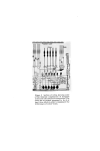
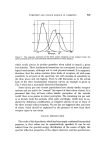
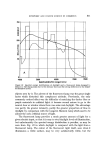
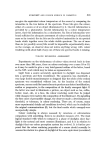
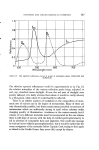
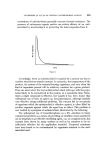
EYI•SWEET AND COLOUR SCIENCE IN COSMETICS 5O7 I-5 0.5 o 400 500 600 700 Wovelength, nm Figure 7 The response functions of the three colour receptors of the normal retina: the spectral sensitivities are deducted from measurements of colour mixture. which would always be positive quantities when added to match a given test stimulus. These fundamental sensations can correspond to real physio- logical mechanisms, although not to real physical stimuli. It is supposed, therefore, that the retina contains three kinds of receptors, all with some sensitivity in all parts of the spectrum, but with maxima of sensitivity in the blue, green and red regions. There is still discussion as to the actual form of the three fundamental sensation curves an example is given in Fig. 7 which has a reasonable theoretical foundation. Some ninety per cent of most populations have closely similar receptor systems and are said to be "normal" {in respect of their colour vision). It is presumed that they all have rather similar perception of the outside world: there is no genius in colour perception. The remaining ten per cent or so deviate from the normals, often quite startlingly, which may be ex- plained by deficiency, modification, or complete absence of one or more of the three normal colour receptors. No one has yet suggested that any form of colour vision should be explained by the presence of more than three receptor types in one retina. COLOUR SPECIFICATION The result of this hypothesis, which has been amply confirmed for practical purposes, is that colour can be quantitatively specified. It can be cal- culated from the spectral energy distribution of the source of light, the spectral reflection properties of the object observed, and the spectral sen-

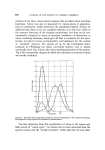
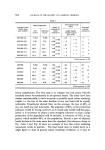
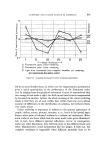
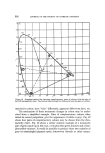
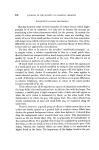
508 JOURNAL OF THE SOCIETY OF COSMETIC CHEMISTS sitivities of the three visual colour receptors (the so-called colour matching functions). Colour can also be measured by various pieces of apparatus, types of calorimeter, which abbreviate the calculation method. It must be admitted that there is not yet complete certainty as to the true values of the response functions of the receptor mechanisms, but they can be con- ventionally evaluated in terms of standard conditions of observation as colour matching functions, which give all that is necessary for the speci- fication of colour in terms of chromaticity and luminance for the normal or "standard" observer. The system set up by the Commission Inter- ß nationale de l'Eclairage has many convenient features and is almost universally used: Fig. 8 shows the colour matching functions of the system, Fig. 9 the chromaticity diagram in which the calculated or measured values are usually exhibited. 2O 1'6 14 1'7--- •.o o.s 0.6 0----/ , 400 500 600 700 Wavelength, nm Figure 8 The CIE colour matching functions: these are analagues to the response functions, but adapted to the purposes of chromaticity measurement. The first deduction from this specification of colour is the nature and finite extent of "colour space": no colours can be more saturated than the spectral colours and the "purple boundary" which joins the red and violet
Purchased for the exclusive use of nofirst nolast (unknown)
From: SCC Media Library & Resource Center (library.scconline.org)