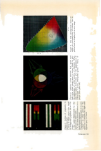
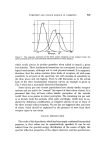
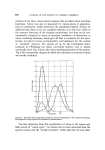
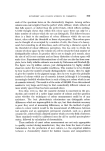
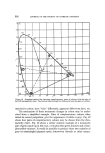
EYESWEET AND COLOUR SCIENCE IN COSMETICS 509 ends of the spectrum locus on the chromaticity diagram. Among surface colours none can be lighter than the perfect white diffuser, which reflects all that falls upon it, or darker than the perfect black, which reflects nothing. A little thought shows that within this colour space there can only be a finite number of colours which the eye can distinguish. This follows because there is a limit to the smallness of colour difference which the eye can detect, often called the threshold or limen of perception. Thus colour space can be thought of as occupied by a number of cells, like those of a honey- comb but extending in all directions, each cell having a diameter equal to the threshold of colour difference perception. One has only to divide the volume of colour space by the volume of a cell to obtain the total number of distinguishable colours. In practice this is not so simple as it sounds, since the size of cell is not constant and no linear distortion of colour space will make it so. Experimental determinations of cell size are also far from com- plete, but a fairly reliable estimate was made by Nickerson and Newhall (8). The figure was 7• million colours, just distinguishable by highly skilled observers under the best possible conditions. This number is to be divided by four to give the number of easily distinguishable colours, then by eight to give the number in the pigment range, then by two to give the probable number of colours which are of cosmetic interest (although it is becoming increasingly doubtful whether there is such a thing as a colour which is not of cosmetic interest). The result is of the order of 100,000. Even this reduced number is very large and it may be that cosmetically different colours are more widely spaced than has been assumed above. It is clear, even so, that the cosmetic chemist is concerned in the pro- duction and control of a rather large number of colours and the question arises whether the techniques of colour measurement could be of any assistance. The best photoelectric colorimeters can distinguish colour differences which are imperceptible to the eye, but their absolute accuracy is poor: they excel at measuring differences, so that the method of appli- cation to colour control would be the measurement of differences between test samples and an appropriate permanent standard, such as a glazed ceramic tile, selected from a limited number which cover the field of interest. These standards would be calibrated once for all by careful spectrophoto- metry, followed by calculation of chromaticity. These methods of exact colour measurement are not only appropriate to quality control during manufacture they also form the basis of colour formulation for the production of new colours, i.e. the empirical relation between a chromaticity desired for fashion reasons and composition in

510 JOURNAL OF THE SOCIETY OF COSMETIC CHEMISTS terms of pigment mixtures. Quality control during manufacture may be very simple in the case of coloured cosmetic products, but it is worth re- membering that quality control by chart methods is only possible when the product can be measured, in this case in terms of chromaticity: the more sensitive the measurement of chromaticity, the earlier the detection of deviation in quality of product. COLOUR ATLASES It is also desirable to mention the nature, possibilities and limitations of colour atlases. A complete colour atlas contains samples of surface colours which cover the whole possible range, and are displayed in some sort of logical manner for ease of reference. In a good colour atlas, the spacing of the colours follows a uniform, reproducible perceptive scheme. With sufficient patience, a logical array of colours can be set up: the Munsell atlas is one of the best, and best known. The colours are so spaced that each is at a perceptually equal distance from each of its neighbours. Unfortun- ately, no atlas can be used for accurate measurement by comparison of an unknown coloured surface with the "chips" of the atlas: adequate repro- ducibility and permanence are not attainable except by doing so many and such frequent measurements that the atlas loses its point. One might as well do the measurements without the atlas. All the same, atlases have their uses, especially when the colours are arranged at equal sensory intervals, as in the Munsell atlas. In so far as design of cosmetic colour schemes is possible, the arrays of equally spaced colours of an atlas provide ideal material for the purpose. The aesthetic and psychological factors of colour harmony, colour contrast, colour rhythm, etc., may be explored with facility, using the atlas chips on various backgrounds, which may be larger specimens of the atlas colours. The details of such aesthetic and psychological factors are outside the scope of this lecture and are, indeed, extremely difficult to investigate: a great deal of work has been rendered futile through ignorance of the known facts of colour perception. It behoves any would-be investigator to make himself thoroughly familiar with these facts before embarking on his aesthetic or psychological journey. ILLUMINATION AND COLOUR So long as an illuminant looks more or less white it is easy to assume that it has no particular importance in the perception of the colours of
Purchased for the exclusive use of nofirst nolast (unknown)
From: SCC Media Library & Resource Center (library.scconline.org)