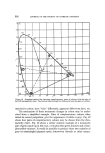
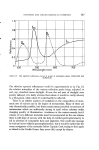
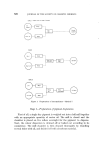
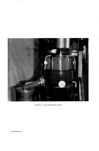
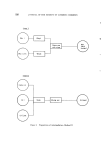
EYESWEI•-T AND COLOUR SCIENCE IN COSMETICS 513 can give the equivalent colour temperature of the source by comparing the intensities in the two halves of the spectrum. Three bits give the colour, either of a source or of an object illuminated by it. One-bit information is provided by a photometer, two-bit information by a colour temperature meter, three-bit information by a colorimeter. Six bits of information were found sufficient for adequate assessment of colour rendering in all practical cases so far treated: the six bits are the relative luminosities in six spectral bands which together cover the whole visible spectrum. The use of more than six (or possibly seven) bits would be impossible experimentally since, on the average, an observer does not notice anything wrong with colour rendering until about half of any one of these six spectral bands is missing. COLOUR RENDERING ASSESSMENT Experiments on the trichromacy of colour vision stretch back in time over more than 100 years, those on colour rendering over a mere 10 or 15, so it may be useful to give a very brief general outline of the latter, based on the NPL work which may be taken as representative. Light from a source accurately equivalent to daylight was dispersed into a spectrum and then recombined. The apparatus was essentially a very large double monochromator so designed that the whole of the central spectrum was recombined without loss. At the location of the central spectrum, screens couldbe inserted so as to produce any desired modification, sudden or progressive, in the composition of the finally emergent light. If the latter was used to illuminate a picture, an object such as tea, coffee, butter, meat, etc., or a face, the colour rendering could then be judged while changes were made in the composition of the illuminant. By signalling the first onset of perceptible change, the observer made a determination of threshold, or tolerance, in colour rendering. There are, of course, many more experimental details and conditions involved, which can be studied in the original communications (9), but the final results which emerged were unexpectedly simple. Colour rendering is always assessed by conscious or subconscious comparison with something, there is no absolute measure of it. The most logical standard with which to compare is a phase of daylight, since day- light is the natural and most common illuminant, and it is in relation to daylight that our colour perception system has evolved. It is further pro- posed that the colour rendering properties of a source should normally be assessed in relation to a phase of daylight of the same equivalent (correlated)

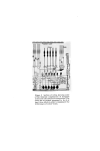
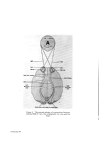
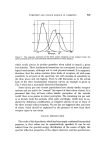
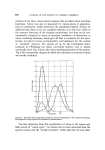
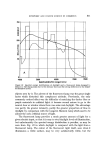
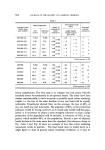
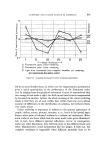
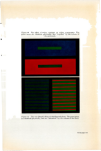
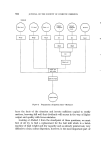
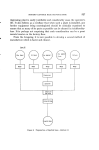
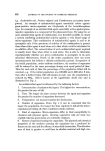
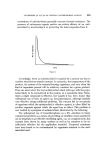
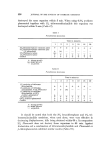
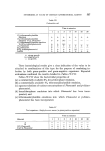
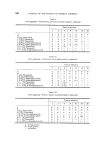
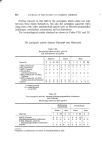
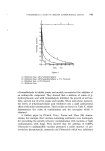
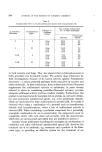
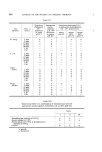
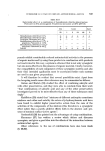
514 JOURNAL OF THE SOCIETY OF COSMETIC CHEMISTS Table I Band luminance Deviations from Spectral band .................... Ratio of unity Excesses limits (nm) luminances outside and number test reference (test/ single bands tolerances source source reference) double bands (per cent) 400-455 (I) 0.431 0.382 1.13 + 13 3 (1.o6) + 6 1 455-510 (II) 7.37 7.51 0.OS -- 2 0 (0.89) --11 6 510-540 (III) 15.0 19.1 0.79 --21 11 (0.94) -- 6 1 540-590 (IV) 48.8 44.8 1.09 q- 9 0 (1.04) •- 4 0 590-620 (V) lS.0 lS.S 0.98 --- 2 0 (1.01) + 1 0 620-760 (VI) 10.3 9.93 1.04 t q- 4 0 Total excesses = 22 400-455 455-510 510-540 540-590 590-620 620-760 0.584 5.92 12.5 55.0 19.8 6.21 0.439 8.07 19.8 44.7 17.6 9.35 1.33 (1.03) 0.73 (0.68) 0.63 (0.93) 1.23 (1.18) 1.13 (0.90) 0.66 q-33 m27 --37 +23 +13 --34 q- 3 --32 --7 +18 --10 23 0 17 27 27 2 13 13 3 5 24 Total excesses =,, 154 colour temperature. The next step is to compare the test source with the standard source for luminosity in six spectral bands. The latter have been chosen experimentally to have as nearly as possible equal colour rendering weight, i.e. the loss of the same fraction of any one band will be equally noticeable. Experiment showed that, on the average, the loss of 40% of any one band was just noticeable. The adoption of 40% as the production tolerance would be wrong, however, as it would only satisfy half the popu- lation: it is necessary to adopt a more stringent tolerance so that a large proportion of the population will be satisfied. A tolerance of 10% is sug- gested, which satisfies 95% of the population. Should a pair of adjacent bands deviate in the same sense from the standard, this tolerance drops to 5%. Table I and Fig. 11 show an example of how this colour rendering assessment works in practice. The final result may be boiled down to a single figure or class of general colour rendering excellence, or it may be
Purchased for the exclusive use of nofirst nolast (unknown)
From: SCC Media Library & Resource Center (library.scconline.org)