J. Soc. Cosmetic Chemists 19 707-711 (1968) ¸ 1968 Society of Cosmetic Chemists of Great Britain The hydrolysis of monostearin in an acidic medium N. A. ARMSTRONG* Synopsis--The hydrolysis of pure and commercial grades of monostearin in mineral acid has been studied. The reaction has been shown to follow first order kinetics, with an activation energy of 76'49 kJ mole-l, and a collision factor of 9.48 min-I. Study of the hydrolysis of pure monostearin in acidic buffer solutions also reveals first order kinetics, the rate of reaction increasing as the pH of the medium is decreased. Monostearin is a widely used emulsifying agent for topical prepara- tions. The commercial material is a mixture of mono-, di-, and triglycerides, usually in conjunction with a soap or other anionic surface active agent, e.g. self-emulsifying monostearin, B.P.C. Because of the soap, the latter is unsuitable for use in acidic media, and is therefore replaced by "acid- stable" forms of monostearin, in which the soap is replaced by a nonionic surfactant. When an "acid-stable" variety of commercial monostearin was used to prepare an o/w cream of pH 3.5, it was found that instability of the emulsion occurred and the possibility of breakdown of the glyceryl ester was con- sidered. Suspensions of the emulgent (0.8 g) in 0.1N mineral acid (50 ml) were stored at elevated temperatures, and the free glycerol content deter- mined at weekly intervals. Typical results for storage of these suspensions at 45øC are shown in Table I, and in view of the rate at which hydrolysis was proceeding, it was decided to investigate the reaction further using pure monostearin. The saponification of higher glycerides has been studied by Jellinek *Welsh School of Pharmacy, University of Wales Institute of Science and Technology, Cardiff. 707

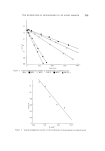
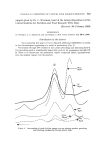
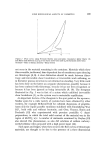
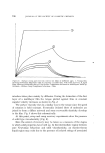
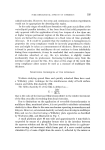
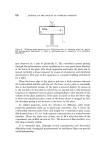
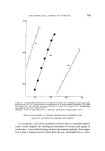
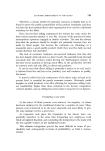
7O8 JOURNAL OF THE SOCIETY OF COSMETIC CHEMISTS Table I Concentration of free glycerol in commercial monostearin maintained at 45øC. Time (weeks) 0 1 2 3 4 Free glycerol (% w/w) 0.80 2.52 3.90 4.90 5.66 and Gordon (1) who showed that the hydrolysis of pure monostearin, monomyristin and mono-olein in alkaline aqueous acetone followed second order kinetics. Patel (2) found pseudo first order rates of reaction in similar experiments, but Patel used a mixture of di- and triglycerides which may have obscured the true course of the reaction. Acid hydrolysis of higher glyceryl esters, on the other hand, has received little attention, though the acid hydrolysis of monoacetin and other lower esters has been found to follow first order kinetics (3, 4), the rate of reaction being strongly pH dependent (5). EXPERIMENTAL Monostearin was prepared by Hartman's method (6), the phase separa- tor described in Hartman's original paper being replaced by a Dean and Stark apparatus. Recrystallization of the product from ether gave mono- stearin, m.p. 80.5øC. lAverill et al give m.p. 81.1øC (7)]. Acetone vas distilled over potassium carbonate, and the middle fraction used in the hydrolysis experiments. 0.268 g of monostearin was added to a mixture of 225 ml acetone and 75 ml 2N hydrochloric acid, maintained at the desired temperature, giving a final concentration of 2.50 m moles monostearin 1- 1. 25 ml samples were removed at intervals, mixed with 60 ml water, and extracted with 3 quantities of 25 ml chloroform. The free glycerol content of the aqueous phase was then determined by oxidation with periodic acid, followed by titration with sodium thiosulphate (8). RESULTS The hydrolysis of monostearin was studied in high concentrations of hydrogen ions over a range of temperatures from 35øC to 55øC. The linear relationship between the logarithm of the concentration and time is shown
Purchased for the exclusive use of nofirst nolast (unknown)
From: SCC Media Library & Resource Center (library.scconline.org)