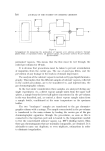
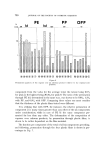
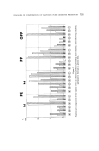
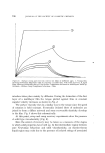
722 JOURNAL OF THE SOCIETY OF COSMETIC CHEMISTS Preceding permeation the concentration of component 2, relative to the total of all six components, is rather low while this ratio has increased following permeation of PE hd, PP and OPP. In the case of the three mentioned films it could be called permeation by preference, or extraction this same feature applies to component 4 by permeating PE hd, while the opposite is true for the same component 4 by permeating PP and OPP in this case one could call the phenomenon sieving. CONCLUSION No information is given on the identity of the components under con- sideration, nor on what component might be characteristic in the organo- leptical sense. No conclusion can be drawn from the results as to what would be the better material for any specific odorous product. One can expect, however, that the greater the thickness of the material, the lower the overall permeation. Nevertheless it seems to be quite realistic that components permeating by preference will deviate considerably from Fick's law by having no linear relation inversely proportional to the thick- ness. This does not exclude, however, the necessity to take into considera- tion the thickness of the material when comparing the permeations. By continuation of the tests variation of the thickness seems to be of primary importance, as well as greater variety of plastic films and odorous products. Concerning the odorous products it could be reasonable to make use of standard compositions. Using these it will be possible to state the permeation in absolute units, while testing can be limited in time by using components of an acceptable low boiling point. This would also permit determination of the optimal speed of the carrier gas. Furthermore it might be interesting to determine if, as a result of pro- duction procedure (tubular blowing of PE ld), the surface condition has any influence on the permeation in general, or the permeation by preference of one or more of the components. Finally, it seems to be of interest to test the influence on the permeation of stresses in the plastic matedhal and of the relative humidity of the odorous vapour. ACKNOWLEDGEMENTS The author is grateful for permission to publish the work done for Koninklijke Shell Plastics Laboratorium, Delft. He acknowledges the

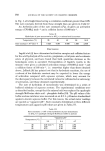
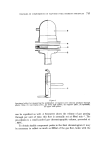
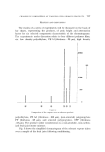
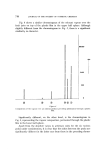
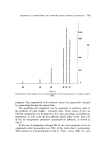
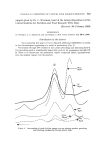
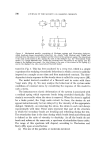
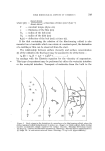
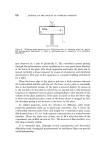
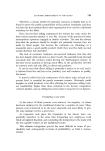
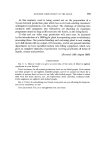
CHANGES IN COMPOSITION OF VAPOURS OVER ODOROUS PRODUCTS 723 support given by Dr. C. Weurman, head of the Aroma Department of the Central Institute for Nutrition and Food Research TNO, Zeist. (Received.' $th February 1968) REFERENCE (1) Wientjes, A. G., Maarse H. and van Straten, S. Mitt. Gebiete Lebensm. Hyg. 58 61 (1967) Introduction by the lecturer Since preparing this paper we have obtained additional information on peaks in the chromatogram appearing as a result of permeation (Fig. 8). Permeation through PP resulted in new peaks preceding and following peak 6. The preceding peak is considerably larger than peak 6, by permeation through PE ld. There is no doubt that the permeated vapour compound differs quantitatively from the original vapour over the product. Figure 8 Surrounding of peak 6 of}the vapour over an odorous product preceding, and following, permeation through plastic films.
Purchased for the exclusive use of nofirst nolast (unknown)
From: SCC Media Library & Resource Center (library.scconline.org)