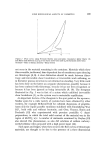
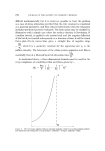
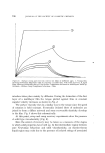
728 JOURNAL OF THE SOCIETY OF COSMETIC CHEMISTS gel-like structure (15). It is considered that the spur is a measure of the gel strength of the system and that the structure has to be broken down before significant flow can occur. The value of the shear stress at the spur point may be referred to as a static yield value, Os although as strictly defined this is applicable only at zero shear rate (15). Although it may be considered as the minimum shear stress required to initiate flow, this is an approxima- tion as the value is not independent of time. Apart from the general axiom of rheology that probably all substances flow providing the time scale of observation is long enough, the viscoelastic measurements to be dealt with later suggest a mechanical model possessing a residual dashpot. This implies that continuous flow is to be expected however small the applied stress. The presence of a minimum in shear stress on the upcurve has sometimes been considered by other workers to be an instrumental characteristic rather than a property of the material (1t3, 17). Although this is a valid consideration for concentric cylinder viscometers, in which plug flow can occur, it is not applicable when a cone and plate viscometer is used, provided the material does not fracture in the gap. The particular feature of this type of instrument is that, provided the angle between the cone and plate is small {less than 4ø), the shear rate is essentially uniform throughout the sample and plug flow does not occur. The linear portion of the down curve of the rheogram may be extra- polated to the shear stress axis to give a dynamic yield value Od' This measures the energy input necessary to maintain a constant ratio of shear stress to shear rate in a system whose structure has been partially or totally disrupted during the determination of the up-curve. The shear rate or duration of shear may be increased until the dynamic yield value reaches a maximum. This represents the energy required to break all the weak secondary bonds between particles and under these conditions the dis- persed units consist solely of primary particles (15). For a plastic system which does not exhibit a hysteresis loop, the dynamic and static yield values are one and the same. Continuous shear methods, such as that illustrated above, subject experimental systems to some agitation and the results obtained may be used to predict and modify the behaviour of products during manufacture and use under conditions where significant shear breakdown occurs. For systems exhibiting complex flow behaviour, such as irreversible shear breakdown and thixotropy, classical parameters such as viscosity and elasticity are not measured as such. An alternative treatment, however, is to examine a material in what may be termed its rheological ground

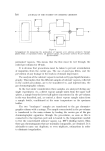
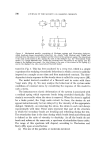
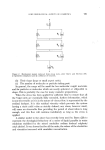
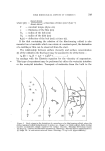
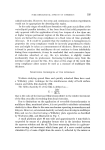
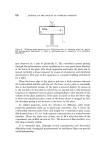
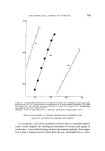
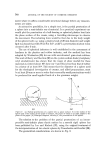
SOME RHEOLOGICAL ASPECTS OF COSMETICS 729 state, i.e. when the method of testing does not significantly alter the static structure. The results of such investigations may be analysed where applicable, on the basis of linear viscoelastic theory as discussed by Turner, Alfrey and Gurnee (18), Ferry (19, 20), and Leaderman (21). Such tests are, in general, time consuming and/or require complex equipment and they are not suitable for routine control but are valuable for the fundamen- tal study of structure. THE NATURE OF VISCOELASTIC BEHAVIOUR The concept of a perfectly elastic solid, for xvhich in accordance with Hooke's Law stress is always directly proportional to strain but independ- ent of the rate of strain, is an idealisation, as is also the notion of a Newton- ian liquid, for xvhich stress is directly proportional to the rate of strain but independent of the strain itself. Under suitable conditions, real solids deviate from Hooke's Law and any real liquid, if subjected to sufficiently precise measurements, would probably be non-Newtonian. There are two important kinds of deviation. First, stress anomalies arise where the strain (in a solid) or the rate of strain (in a liquid) may not be directly proportional to the stress but may depend on stress in a more complicated manner. Second, time anomalies are present xvhen the stress depends on both the strain and the rate of strain such anomalies reflect a behaviour which is both liquid-like and solid-like and is therefore called viscoelastic. Both stress and time anomalies may coexist but when only the latter are present the behaviour is linear viscoelastic. Then the ratio of stress to strain is a function of time alone and not of the stress magnitude. Linear viscoelastic behaviour thus applies to cases where elastic effects obey Hooke's Law and viscous effects are Newtonian (20). In general this means limiting the deformation to the region of small strains (18). In many instances it is because of this criterion that experimental apparatus is complex. For a material exhibiting linear viscoelastic behaviour, the mechanical properties can be duplicated by a model consisting of, for example, a com- bination of Hookean springs and Newtonian dashpots. Fig. 2 illustrates two such models. This model representation is useful, though not essential, to the develop- ment of viscoelastic theory. The models have neither more nor less validity than the mathematical equations which they represent. As an example of the derivation of a model representing an experimental system, we may consider the dispersion for which the continuous shear rheogram is illus-
Purchased for the exclusive use of nofirst nolast (unknown)
From: SCC Media Library & Resource Center (library.scconline.org)