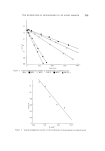
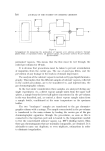
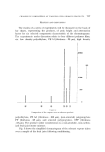
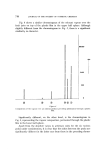
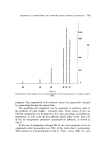
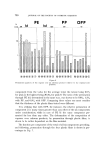
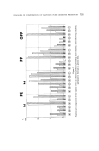
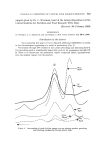
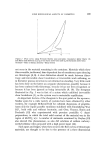
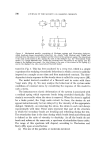
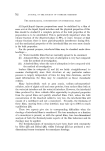
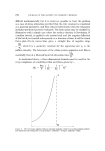
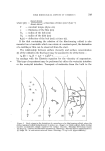
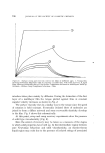
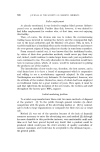
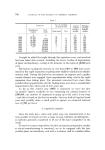
736 JOURNAL OF THE SOCIETY OF COSMETIC CHEMISTS Figure 6. Surface creep and recovery curves for films of different ages. 1. Young film, showing Newtonian behaviour with no recovery. 2. Older film, with some recovery. 3. Aged films, rheology essentially that of Voigt Solids. Compliance decreases as multilayers build up. Ordinate--Surface Creep Compliance abscissa--Time interface takes place mainly by diffusion. During the formation of the first layer of a multilayer film the torque plotted against time at constant angular velocity increases as shown in Fig. 4. The surface viscosity rises in a similar way to the torque since the speed of rotation is held constant. Eventually isolated islets of molecules are joined to form a diffuse network and some recoverable elasticity develops in the film. Fig. 5 shows this schematically. At this point, creep and creep recovery experiments show the presence of solid type viscoelasticity (Fig. 6). Here the extent of recovery may be taken as a measure o[ the degree to which solid properties have built up. In the intermediate region between pure Newtonian behaviour and solid viscoelasticity, an elasticoviscous liquid region may exist due to the presence of isolated strings of associated

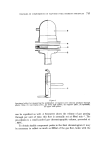
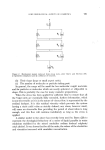
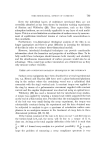
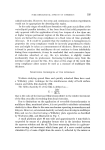
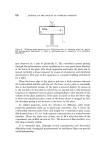
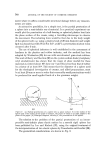
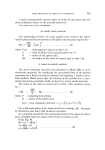
SOME RHEOLOGICAL ASPECTS OF COSMETICS 737 colloid molecules. However, the creep and continuous rotation experiments would not be appropriate for detecting this region. In the early stages of multilayer formation with gum acacia films at the water/liquid paraffin interface, it has been found that solid properties are only apparent •vith the application of very low torques of a fexv dyne cm at higher torques permanent rupture of the film occurs. As successive film layers are formed the creep compliance at a fixed value of time gradually decreases. If it could be assumed that the multilayer is homogeneous in properties the creep compliance would be inversely proportional to thick- ness and might be taken as a measurement of thickness. However, since it is found in practice that multilayers do not continue to form indefinitely during these experiments, it may be concluded that each successive layer of molecules adsorbed, at say, the w/o interface, is slightly weaker mechanically than its predecessor. Increasing hydration away from the interface could account for this. It is clear at this stage of the work that creep compliance alone cannot be used as a measure of multilayer film thickness. STRETCHING TECHNIQUES AT THE INTERFACE Workers studying spread films and quickly adsorbed films have used a Wilhelmy plate technique for the simultaneous study of both surface tension and Gibbs film elasticity (33). The Gibbs elasticity E of the film is defined as:-- 2doff E = dln X that is the ratio of the increased film tension (2d•') to the relative increment of the film area (din A) resulting from local extension. Due to limitations on the application of reversible thermodynamics to multilayer films, mentioned above, it is not possible to attribute extensional elasticity in these films to the same mechanism operating in monolayers and bilayers. However, extensional elasticity certainly does develop in multilayer films and can be observed using a Wilhelmy plate apparatus as described by Warbuton (34), and illustrated in Fig. 7. A small platinum plate 10 mm wide and approximately 1 mm thick is suspended by means of a phosphor bronze wire in the interface between the aqueous solution and the oil. The force measuring device is a galvano- meter moving coil movement which forms part of a servo control system stimulated by a beam of light from the source S, reflected by the mirror m
Purchased for the exclusive use of nofirst nolast (unknown)
From: SCC Media Library & Resource Center (library.scconline.org)