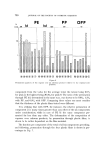
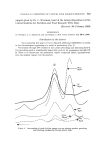
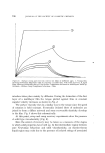
724 JOURNAL OF THE SOCIETY OF COSMETIC CHEMISTS DISCUSSION MR. C. E. Hm•s: It seems to me that we have here a system which might promptly give us some indication of the extent to which perfume moderation might be predicted in plastic containers. We are all prepared to accept weakening of perfumes provided it is not too expensive, but we are always worried that we might start with a very nicely perfumed product and finish up with one that is positively offensive. Are you aware of any work in relation to plastic containers, and the loss of particular constituents of the more popular odour forms normally used in toiletries? TIlE LECTURER: No. DR. J. J. MAUSNER: Could you give us at least some indication of the chemical characteristics of the various fractions that were used in these experiments? The differences in permeation of some of these is very striking indeed and knowledge of the approximate chemical composition of some of them would be very useful. THE LECTURER: Peak 3 might be ethanol, but I have no other information. MR. m. E. BUTTERFIELD: HaS any work been done on the effect of surface treat- ments on permeability, other than surface conditions due to manufacturing processes? THE LECTURER: We have not done any work in this field. MR. C. PuGH: Is your apparatus capable of adaptation so that at the same time as you take a chromatogram somebody could try to smell the differences in the materials and obtain some link-up in this way? THE LECTURER: In our tests we sampied the beverage before and after, but could hardly• tell any difference. Perhaps a panel test would show up something. MR. D. B. VINCE: Have you already tackled PVC film? TIlE LECTURER: The work on PVC is not yeL complete. In Fig. 8, however, you will note very low overall permeation of PVC {30 [tm thickness).

J. Soc. Cosmetic Chemists 19 725-744 (1968) ¸ 1968 Society o.f Cosmetic Chemists of Great Britain Some rheological aspects of cosmetics B. W. BARRY* and B. WARBURTON? A lecture delivered before the Society of Cosmetic Chemists of Great Britain on 2nd May 1968. Synopsis--Both continuous shear rheometry and viscoelastic measurements are valuable in cosmetic technology and some aspects of these techniques are discussed, with particular reference to disperse systems and interfacial films. INTRODUCTION Cosmetic products range in consistency from fluid to solid with many showing both liquid and solid properties. A comprehensive study of these materials would, therefore, encompass the entire field of rheology. The present paper, in general, is limited to some aspects of the flow properties of systems of which the authors themselves have a direct research interest, i.e. disperse systems, in particular semi-solid emulsions, and interfacial films. It is hoped, however, that the problems to be dealt with will be of more than specific interest as the methods of approach are widely applic- able. Particular emphasis will be paid to the concept of viscoelasticity, a subject which has in the main been neglected by biological and chemical scientists, possibly because of its mathematical complexity. However, as so many of the systems dealt with in, for example, cosmetics and pharmacy, show pronounced viscoelastic effects, it is 'felt that attempts to employ the techniques which have been of such value in the polymer field will yield worthwhile rheological information. *School of Pharmacy, Portsmouth College of Technology. $School of Pharmacy, University of London. 725
Purchased for the exclusive use of nofirst nolast (unknown)
From: SCC Media Library & Resource Center (library.scconline.org)