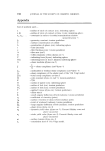
744 JOURNAL OF TItE SOCIETY OF COSMETIC CHEMISTS Appendix List of symbols used:-- a (t) a 1, a 2, . . . b h t x A E F F(t) G J Jo Ji J(t) K P R R• R2 T 01 Gd =radius of circle of contact (cm): indenting sphere =radius of circle of contact at time t (cm): indenting sphere =constants in surface viscosity/concentration relation [(concentration)-- =geometry constant: torsion pendulum ---surface concentration of colloid =penetration of sphere (cm): indenting sphere :-time (seconds) -=film thickness (cm): torsion pendulum = film area (cm 2) •--Gibbs elasticity of film (dynes cm-1) --indenting force (dynes): indenting sphere -=indenting force at time t (dynes): indenting sphere =shear modulus (dynes cm-2) 1 -- shear compliance (cm2 dyne-l) --G =unshunted or residual shear compliance (cm2 dyne-l) =shear compliance of the elastic part of the 'i'th Voigt model = total creep compliance at time t --wire constant (dyne cm rad-1): torsion pendulum :radius of sphere (cm): indenting sphere :radius of bob (cm): torsion pendulum =radius of dish (cm): torsion pendulum :applied torque (dyne cm): torsion pendulum) --shear strain ---small angular deflection of bob (radians): torsion pendulum =coefficient of viscosity (poise) ==surface viscosity of clean solvent (surface poise) =twist of wirehead (radians): torsion pendulum =large angular deflection of bob (radians): torsion pendulum :shear stress (dyne cm-2) ---dynamic yield value (dyne cm-2): Ferranti Shirley cone and plate viscometer =static yield value (dyne cm-2): Ferranti Shirley cone and plate viscometer ---surface tension (dyne cm-1) ::--retardation time of Tth Voigt model.

,[. Sac. Cosmetic Chemist• •.9 745-753 (1968) (C) 1968 Society of Cosmetic ('hemistx of Great Britain Economic employment of the blind possible solution R. D. PURSER* Presented at the •¾mposium on "Processing and Manu- facturing", organised by the Society of Cosmetic Chemists of Great Britain, at Leamington, Warwicks. on 14th November 1967. Synopsis--A brief history of the problems of employing blind persons in sheltered workshops, and details of a revolutionary approach being adopted in the Northampton Blind Employ- ment factory to provide m,odern economic employment within the field of the toiletries industry. HISTORY The first essential in studying the problem of employment of the blind is a brief knowledge of the long history of sheltered workshops for the blind. For centuries it was assumed that the blind were unemployable. However, at the end of the 18th century and during the earlier years of the 19th, a number of schools were established by charitable organizations in which, amongst other things, the blind were taught certain industrial handcrafts which proved to be within their capabilities. The main occupa- tions taught in those early days were basket making, mat making, cane work and hand knitting for women and girls. These remained the main occupations for the blind until recent years and have become known as "the traditional blind trades". By 1874 there were still only 800 blind people in workshops in the United Kingdom, although there were thousands un- employed. In 1889, a Royal Commission recommended that a workshop *Northamptonshire (Town & County) Association for the Blind, Northampton. 745
Purchased for the exclusive use of nofirst nolast (unknown)
From: SCC Media Library & Resource Center (library.scconline.org)