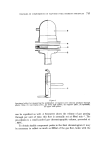
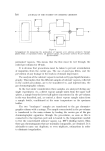
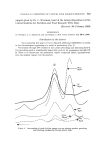
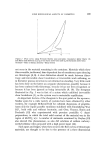
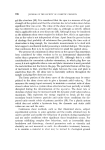
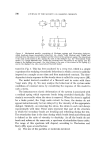
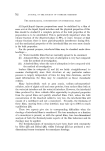
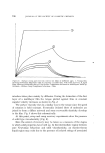
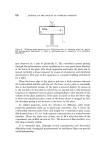
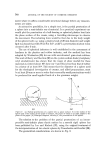
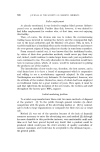
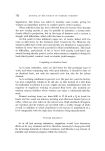
74O JOURNAL OF THE SOCIETY OF COSMETIC CHEMISTS meter where it suffers considerable structural damage before any measure- ments are taken. An attractive possibility, for a simple test, is the partial penetration of a sphere into a semi-infinite sea of material. In a practical experiment one would plot the penetration of a ball-bearing or spherical plastics bead into the plane surface of the cream, using a travelling microscope to observe the movement. The indenting force would be that due to the body weight of the sphere itself, e.g. using a plastics bead of 20 mm diameter and weight 3g it was found that with Wool Fat B.P. at 22øC a penetration of about 1 mm occurred after 3 min. The use of spherical indentors is well established in the assessment of hardness in the plastics and rubber industry, and the method has been adapted by Warburton (35) for use with unvulcanised gum stock rubbers. The work of Barry and Shotton (36) on the system sodium dodecyl sulphate/ cetyl alcohol/water has shown that the range of shear moduli for these materials is centred about 103 dyne cm-2 and this is less than that of rubber by a factor of at least 104. This means that the diameter of a sphere used for the rheological investigation of creams, and allied preparations, must be at least 20 mm or more in order that reasonably small penetrations would be produced for small applied loads of a few grammes xveight. (a) • A (b) Figure 9. (a) Partial penetration of a sphere into a plane surface. R is the radius of the sphere and a the radius of the circle of contact, the plane of which is at right angles to the plane of the paper. (b) Enlarged diagram, showing h, the penetration of the sphere. The solution to the problem of the partial penetration of an incom- pressible semi-infinite plane elastic surface by a smooth rigid sphere has been published by Lee and Radock (37), using the original treatment of the interpenetration of two elastic spheres by Timoshenko and Goodier (38). The geometrical considerations are shown in Fig. 9.

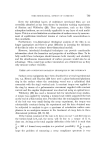
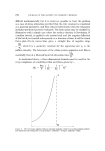
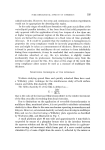
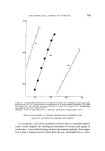
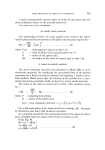
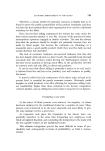
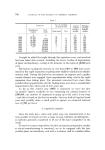
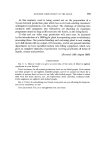
SOME RHEOLOGICAL ASPECTS OF COSMETICS 741 A hard, incompressible smooth sphere of radius R cm presses into the plane horizontal surface of the material under test. T•vo cases are to be considered: .... An ideally elastic material The relationship between the total applied force between the sphere and the plane and the penetration of the sphere into the plane is given by:-- F(t) -- 3R a(t) ........................ (1) where F (t) G R a(t) = indenting force (dyne) at time t (s) -- shear modulus of the material (dyne cm-2) = radius of the sphere (cm) = the radius of the circle of contact (cm) at time t (s). A linear viscoelastic material The above treatment has now been extended by Bland (39) to cover viscoelastic materials. By considering the operational form of the general expression for a linear viscoelastic material and applying a Laplace trans- form method, Bland shows that the solution of the problem for a visco- elastic material is essentially similar to that for a purely elastic material. The radius of the circle of contact a(t) at time t after loading is given by:-- 3RF a3(t) = 8 J(t) ........................ (2) where F = indenting force (dyne) R = radius of the sphere (cm) n J(t)= creep compliance function = Jo+Z Ji (1-e-t/•i)d- qø t 1 For a full explanation of the terms involved in defining J(t) the paper by Warburton and Barry (22) should be consulted. In a practical experiment the actual penetration of the sphere (h cm) is more accessible than the radius of the circle of contact (a cm). From Fig. 9b. R2=a2 d- (R-h)2 a2=2Rh - h2 I a3=(2Rh - h2) 312J ............................ (3)
Purchased for the exclusive use of nofirst nolast (unknown)
From: SCC Media Library & Resource Center (library.scconline.org)