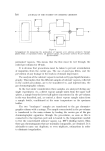
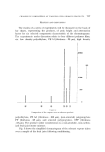
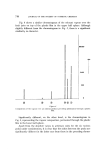
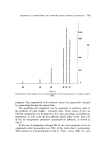
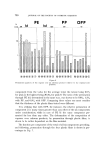
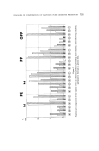
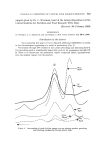
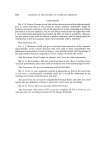
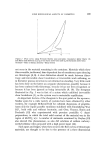
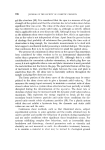
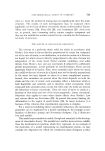
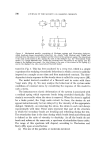
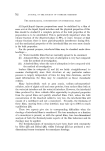
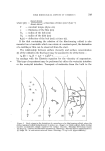
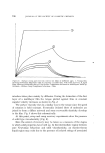
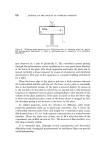
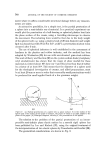
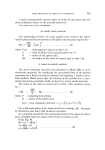
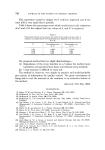
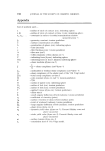
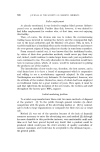
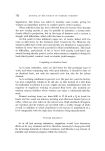
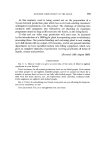
730 JOURNAL OF THE SOCIETY OF COSMETIC CHEMISTS •i. [). Figure oe Mechanical models, consisting of Hookean springs and Newtonian dashpots, which duplicate linear viscoelastic behaviour. (a)--Single Voigt (Kelvin) unit. Under any external force the strain in the dashpot and the strain in the spring are equal. The total stress is the sum of the stress in the spring (o•) and in the dashpot (o,). (b)--Generalised Voigt model. (c)--Single Maxwell unit. Under any external force the stress in the spring and the stress in the dashpot are equal the total strain is the sum of the strains in the spring and in the dashpot (¾2). (d)--Generalised Maxwell model. trated in Fig. 1. This has been analysed by a creep test, which is a simple experiment for studying viscoelastic behaviour in which a stress is suddenly imposed on a sample at zero time and then maintained constant. The time- dependent strain response to this steady stress is called the creep curve (18). The model derived consisted of a Maxwell unit in series with three Voigt units (Fig. $). We may analyse the behaviour of the system under conditions of constant stress by considering the response of this model to such a stress. The instantaneous elastic deformation of the system is associated with a residual spring which represents bonds being stretched elastically. This strain is recoverable when the stress is removed. When the stress is applied for a finite period, the Voigt units extend. In these, the strains do not appear instantaneously but are delayed by the viscosity of the appropriate dashpot. Similarly, on removing the stress, the strain in each unit decays exponentially with time. These units represent that part of the structure in which the secondary bonds are breaking and reforming during the test. The retardation time is the time during which bonds break and reform and is defined as the ratio of viscosity to elasticity. As all the bonds do not break and reform at the same rate, a spectrum of retardation times exists. The range of this spectrum will depend, according to Warburton and Barry (22), upon several factors: (a) The size of the particles or molecules involved.

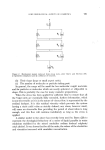
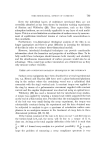
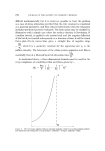
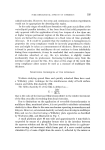
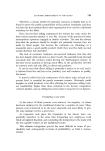
SOME RHEOLOGICAL ASPECTS OF COSMETICS 731 Figure 8 Mechanical model, deduced from creep tests, after Barry and Shotton (3(•). J represents compliance and •1 coefficient of viscosity. (b) Their shape (large or small aspect ratio). (c) The number of molecules or particles taking part. In general, the range will be small for low molecular weight materials and for particles or molecules which are nearly spherical or ellipsoidal in shape. This is probably the case for many cosmetic preparations. When the stress has been applied for sufficient time to ensure that all the Voigt units are essentially fully extended, further deformation, which is non-recoverable as it is in the nature of viscous flow, is represented by the residual dashpot. It is this residual viscosity which prevents the system having a static yield value as strictly defined any stress, however small, will cause an observable flow providing the period of observation is long enough, and this flow will continue indefinitely as long as the stress is applied. A similar model to the above has recently been used by Barry (23) to represent the rheological behaviour of a series of liquid paraffin in water emulsions stabilised by the mixed emulsifier sodium dodecyl sulphate/ cetyl alcohol. It was shown that for all the units, the values of the elasticities and viscosities increased with emulsifier concentration.
Purchased for the exclusive use of nofirst nolast (unknown)
From: SCC Media Library & Resource Center (library.scconline.org)