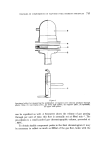
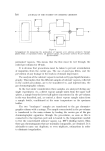
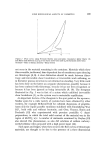
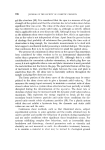
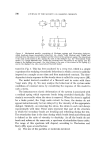
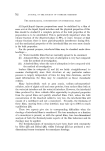
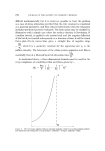
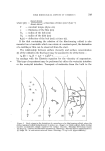
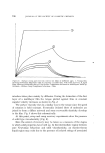
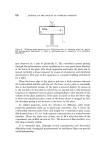
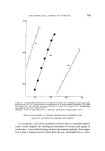
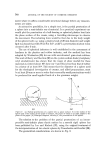
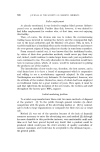
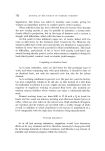
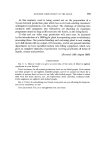
738 JOURNAL OF THE SOCIETY OF COSMETIC CHEMISTS Figure 7. Wilhelmy plate apparatus after Warburton (34). w--platinum plate, m--mirror and galvanometer movement, s--light, p--photocells and h---leadscrew with calibrated micrometer. and observed by a pair of photocells P. The controlled current passing through the galvanometer coil at equilibrium is a very good linear function of the force on the plate. The whole apparatus and hence the plate can be moved vertically a known amount by means of a leadscrew and calibrated micrometer h. This part of the apparatus is a standard milling attachment for a lathe. When the lower edge of the plate is put into a fresh interface between the hydrocolloid solution and the oil, the force on the plate is essentially due to the interfacial tension. If the plate is lowered slightly by means of h, the net force on the plate is reduced by an amount due to the increased buoyancy or displaced aqueous phase corresponding to that fraction of the volume of the plate immersed. If the plate is raised so that the lower edge is above the interfacial plane, some of the lower phase is dragged up into the oil phase giving a net increase in the force on the plate. As colloid molecules reach the interface by diffusion, solid elastic properties gradually build up as previously described. Fig. 8 shows the relationship between plate force and height for a multilayer gum acacia film formed from a 1% w/v bulk aqueous concentration at a water/benzene interface. There are three sets of data, one at 44 h after the start of the experiment, one at 63 h and one at 71 h. The increase of film elasticity over this time is clearly visible. It is concluded that, although several experimental and theoretical difficulties exist, rheological measurements on multilayer films can provide useful informa tion.

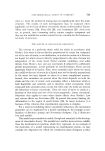
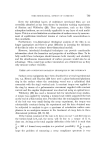
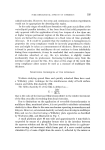
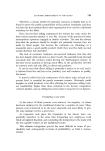
15.5 -- SOME RHEOLOGICAL ASPECTS OF COSMETICS 739 14'5 13'5 (b 40 50 60 70 Figure 8. Relationship between force on plate and height for a multilayer gum acacia film formed from a 1 • w/v bulk aqueous concentration at a water/benzene interface. (a)--after 44 h, slope=0.1, (b)--after 63 h slope=0.15 and (c)--after 71 h slope=0.17. All gradients expressed in dyne cm -! (inch X 10-3) -1 Ordinate--Force on plate (dyne cm-1). Abscissa--Micrometer setting (inch x 10-3). THE DEVELOPMENT OF SIMPLE RHEOLOGICAL METHODS FOR QUALITY CONTROL OF CREAMS AND PASTES In conclusion, it has been considered useful to discuss a possible method which would simplify the rheological assessment of creams and pastes in production. A great disadvantage of most rheological methods of investiga- tion is that a sample must be taken from the pot, and loaded into a visco-
Purchased for the exclusive use of nofirst nolast (unknown)
From: SCC Media Library & Resource Center (library.scconline.org)