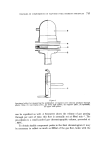
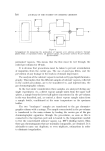
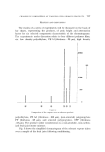
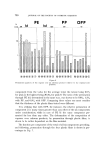
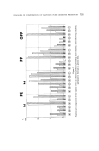
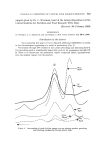
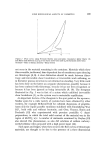
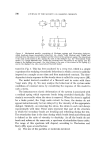
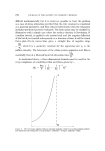
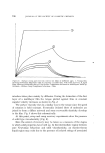
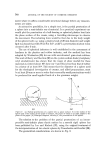
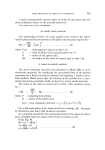
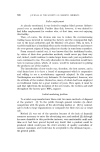
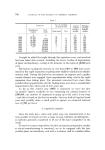
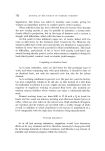
734 JOURNAL OF THE SOCIETY OF COSMETIC CHEMISTS difficult mathematically but it is, however, possible to treat the problem as a case of stress relaxation provided that the wire constant is considered as a material parameter, and then removed afterwards when the relaxation modulus spectrum has been evaluated. The latter point may be clarified by illustration with a simple case where the surface viscosity is Newtonian. If a sudden twist 0•, is applied to the torsion head and the angular deflection of the bob 03 is recorded subsequently as a function of time, it will be found that a plot of in 0• versus time gives a straight line of negative slope bK ---- where b is a geometry constant for the apparatus and •s is the qs surface viscosity. The behaviour of the whole system, apparatus and film, is bqs essentially that of a Maxwell liquid of relaxation time K As mentioned above, a three-dimensional formula must be used for the creep compliance of a multilayer film and this is given by:. 4•x{ 1 1 }-1 J(t)- T 'R• R • • --2 A B l,'igure ,t Plot of torque against time at constant angular velocity for a film-forming colloid. AB represents the formation of a monolayer, Ordinate--Torque abscissa---Time.

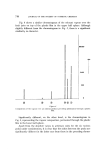
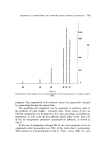
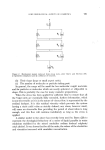
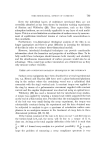
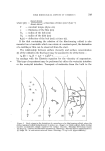
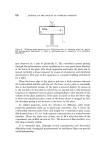
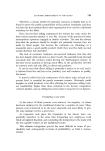
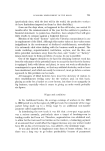
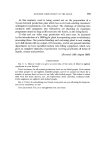
SOME RHEOLOGICAL ASPECTS OF COSMETICS 735 shear strain where J(t) -- shear stress' a function of time (cm2 dyne-i) T : constant torque (dyne cm) x = thickness of the film (cm) R 1 --- radius of the bob (cm) R 2 = radius of the dish (cm) 02(t) = deflection of the bob (rad) at time t(s). If the dish containing the solution of the film-forming colloid is also mounted on a turntable which can rotate at constant speed, the formation of a multilayer film can be observed from the start. The relationship between surface viscosity and surface concentration (•) of the colloid in the first layer may be assumed to be of the form:-- •ls (•) = •ls (1 q- ale q- a2(•)2-•- ............ ) by analogy with the Einstein equation for the viscosity of suspensions. This type of experiment may be performed at either the water/air interface or the water/oil interface. Transport of molecules from the bulk to the Figure $ Early stages in the formation of a monolaycr of a film forming colloid, where the circles represent colloid molecules (not to scale). (a)--Stage I, in which isolated, fairly circular clusters of molecules simply augment the surface viscosity. Rheology-Newtonian liquid. (b) Stage II-•clusters become more asymmetric. Rheology--•,laxwell liquid (approximately). (c) Stage III--a continuous network forms. Rheology Voigt solid (approximately).
Purchased for the exclusive use of nofirst nolast (unknown)
From: SCC Media Library & Resource Center (library.scconline.org)