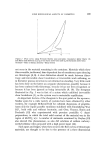
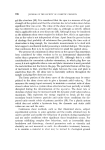
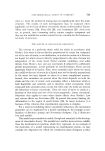
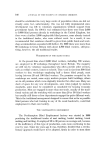
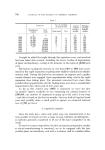
750 JOURNAL OF THE SOCIETY OF COSMETIC CHEMISTS Table I Turnover No. of workers at end of year Annual National overall average Traditional New loss per loss per trades trade Traditional New worker worker -- 1958 19,317 -- 35 -- 334 436 1959 17,185 9,042 25 10 326 443 1960 16,248 36,599 24 13 128 471 1961 15,520 i 79,435 24 13 262 501 1962 13,368 110,893 13 19 378 558 1963 9,227 131,220 2 28 343 586 1964 -- 179,342 -- 32 218 630 1965 -- 237,366 ..... 32 134 670 1966 -- 331,000 -- I 36 61 720 It nfight be added that right through this operation every cost involved has been taken into account, including the heavy burden of depreciation of plant and machinery, costing at the moment, in the region of oe8,000 each year. The factors causing the increase in cost from 1961 to 1963 were occas- ioned by the rapid expansion requiring more skilled technical and admini- strative staff. During this period an accountant, an engineer and a quality control chemist were engaged, these appointments being vital in the rapid expansion then taking place. The personnel concerned have more than justified their appointments and the trading losses now show a considerable improvement since their peak of four years ago. As far as this current year (1967) is concerned we have the first six months' figures available we are estimating our annual turnover at oe390,000, our number of employees is going up to 42, and it is our hope --and this is based on the first six months--that we shall at long last break even and, possibly make a small profit as against an estimated national loss of oe790 per head. A competitive industry Since the early days, •vhen only toilet soap was manufactured, it has been possible to branch out into a range of soap, toiletries and detergents - an industry generally considered to be one of the most competitive in the world. To survive in open competition, the first and maj or prerequisites, insofar as actual manufacturing is concerned, are to be equipped with the best possible plant and machinery and with a technical staff of a similar calibre

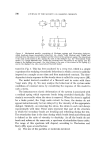
ECONOMIC EMPLOYMENT OF TItE BLIND 751 (particularly since, with the best will in the world, the productive workers do have limitations imposed on them by their disability). Gone are the days when, as happened in the old trades, one waited 15 months after the commencement of the year for the auditors to produce a financial statement. A system has, therefore, been adopted that will give daily results to compare against a budgeted forecast. Mention of the word "factory" raises the Victorian nomenclature in use in employment of the blind. Although this matter taken at face value seems insignificant in the environment of sheltered establishments, nevertheless it is extremely vital when dealing with the business world in general. The words workshop, superintendent, institution, asylum, and the like, can drive potential customers away from the door, and "works" or "factory" means much more to them provided, of course, its use is justified. One of the biggest obstacles to be faced in obtaining contract work has been the reluctance of the potential buyer to accept the fact that the factory is equipped, both with labour and plant, to carry out work as efficiently as counterparts in open industry, so that any artificial obstacles, such as have been mentioned, and which can easily be removed, must go before a serious approach to this problem can be made. All managers of blind factories have heard the old story of visitors to their establishments feeling sorry for the workers and, on this basis, placing an order for a basket or a new broom, but there is no sympathy in big business, especially when it comes to giving an order worth probably six figures. Wages and conditions In the traditional trades, the average earnings of workers in the 1950 to 1960 period was in the region of oe120 per head, the remainder of the wage packet being made up to a living wage by an additional non-taxable payment called augmentation. In introducing the new trade it was felt that a two-part wage packet was a serious anomaly, particularly since a target of breaking-even in trading results had been set. Therefore, augmentation was abolished and, to allow for the increased tax burden on the workers, a balancing payment of an amount that would offset the biggest increase any one worker would have felt on his or her income tax, was added to the minimum wage. It was also desired to implement some form of bonus scheme, but as there was a long way to go before productivity became of paramount
Purchased for the exclusive use of nofirst nolast (unknown)
From: SCC Media Library & Resource Center (library.scconline.org)