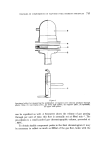
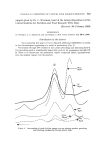
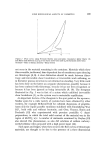
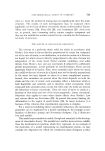
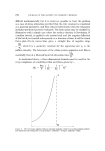
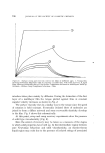
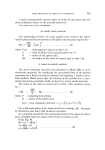
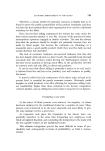
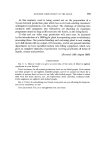
726 JOURNAL OF THE SOCIETY OF COSMETIC CHEMISTS THE EXAMINATION OF MATERIALS BY CONTINUOUS SHEAR RHEOMETRY Probably the most •videly used methods employed in rheology today use rotational instruments to derive the flo•v curves •vhich indicate the relationship of shear stress to rate of shear bet•veen suitable limits. Essenti- ally these instruments comprise t•vo members, separated by the material under test, which are able to rotate relative to one another about a common axis of symmetry. As one member rotates, the other tends to be dragged round •vith it, i.e. the test material transmits a torque to the second mem- ber. In all rotational viscometers it is the relationship between the torque and the relative angular velocity which is used to characterize the rheo- logical properties of the test material. As an example of the use of such an instrument we may consider part of an investigation by Barry and Shotton (1) performed on a mixed emulsi- fier (sodium dodecyl sulphate and cetyl alcohol) dispersed in •vater. This was a complex, metastable system which ranged from a fluid to a gel-like consistency, depending on the concentration. The instrument used was a Ferranti-Shirley cone and plate viscometer •vhich has been described by McKennell (2-4) and Van Wazer, Lyons, Kim and Col•vell (5). Preliminary experiments sho•ved that, at a given rate of shear, the shear stress fell steadily •vith time of shearing in general, an equilibrium-shear stress was not obtained even after 30 min. The materiM could thus not be considered simply as Newtonian, dilatant, pseudoplastic or plastic. The instrument •vas used therefore in conjunction with an automatic flow curve recorder unit to provide a standardized shearing procedure for materials •vhich exhibit shear and time-dependent flo•v behaviour. The control unit was designed to give uniform acceleration of the cone from zero to a preset maximum speed and then to decelerate uniformly, and its performance has been dealt with by Barry and Shotton (6). The resulting flo•v curves •vere displayed on an X-Y autoplotter, and a typical curve is illustrated in Fig. 1. The flo•v curve •vas in the form of a hysteresis loop in •vhich the "do•vn" curve lay to the left of the "up" curve, and the area of the loop •vas a measure of the amount of structure breakdo•vn •vhich had taken place. The information gained in this kind of experiment is useful in formulating, for example, lotions which are to be of such a consistency that dispersed solids are maintained in suspension when in the container, but the lotion becomes sufficiently fluid on shaking to be poured. In addition, it is import- ant that structure should rebuild upon re,tinõ, so that sedimentation does

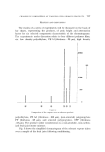
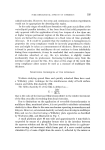
SOME RHEOLOGICAL ASPECTS OF COSMETICS 727 Figure 1 Flow curve, using Ferranti Shirley cone and plate viscometer [after Barry (7) and Barry and Shotton (1)]. •s is the static yield value and •d the dynamic yield value. Ordinate--Rate of Shear abscissa--Shear Stress not occur in the material remaining in the container. Materials which show this reversible, isothermal, time-dependent loss of consistency upon shearing are thixotropic (4, 8). A clear distinction should be made between thixo- tropy and irreversible shear breakdown or irreversible work softening, as in the latter process structure is not reformed on standing. Very little work has been done on the latter as a separate phenomenon, possibly because it has been confused with thixotropy, because it has not been recognised, or because it has been ignored as being intractable (9, 10). The rheogram illustrated in Fig. 1 was in fact of a sytem which exhibited irreversible shear breakdown (1), as the system was in metastable equilibrium. An important feature of the rheogram is the spur point on the up-curve. Similar spurs for a wide variety of systems have been obtained by other workers, for example McKennell (2) for colloidal dispersions of graphite, Axon (11) for liquid paraffin emulsions stabilised with Emulsifying Wax B.P., both with and without bentonite, and Ober, Vincent, Simon and Frederick (12) who experimented with procaine penicillin G depot preparations, in which the total solid content of the material was in the region of 40-70% w/v. A number of ointments examined by Boylan (13) also showed this phenomenon, as also did solutions of sodium carboxy- methylcellulose when prepared with a high power input (14). Such spurs and bulges, when they occur in the flow curves of thixotropic materials, are thought to be due to the presence of-a three dimensional
Purchased for the exclusive use of nofirst nolast (unknown)
From: SCC Media Library & Resource Center (library.scconline.org)