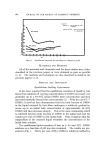
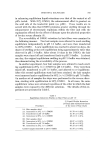
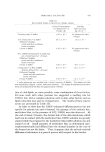
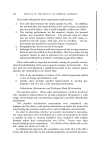
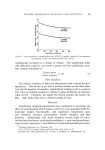
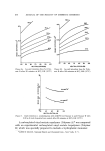
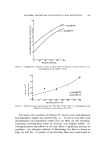
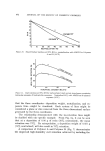
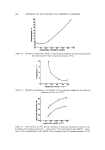
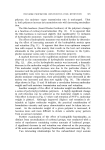
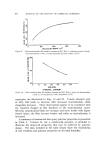
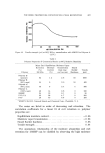
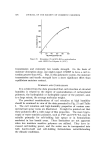
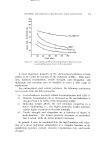
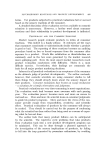
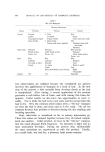
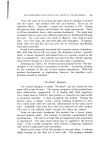
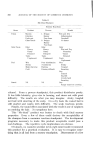
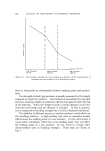
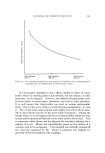
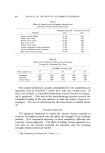
DIMETHYL SULFOXIDE 843 in enhancing equilibrium liquid retentions over that of the control at all pH's tested. With 70% DMSO, the enhancement effect is greatest on the acid side of the isoelectric point (ca. pH5). These results are in accord with the idea that DMSO promotes greater swelling through the enhancement of electrostatic repulsions within the fiber and with the explanation offered for the effect of dioxane upon the physical properties of bovine serum albumin (3). The reversibility of DMSO retention by hair fibers was examined in the following manner. Two hair samples were allowed to reach swelling equilibrium independently in pH 7.0 buffer, and were then transferred to 100% DMSO. A new equilibrium was reached in about two days, the degree of swelling at the new equilibrium being approximately twice that observed in pH 7.0 buffer. After about 10 days in the DMSO, the hair samples were rinsed off and transferred back to pH 7.0 buffer. In about one day, the original equilibrium swelling in pH 7.0 buffer was obtained, thus demonstrating the reversibility of the process. In another experiment, four hair samples were allowed to reach swell- ing equilibrium in 20% (v/v) DMSO in pH 7.0 buffer. They were then rinsed off, transferred to pH 7.0 buffer, and allowed to re-equilibrate. After this second equilibrium state had been attained, the hair samples were immersed and re-equilibrated in 80% (v/v) DMSO in pH 7.0 buffer. On another set of samples the steps were performed in the reverse direc- tion, starting with equilibration in 80% DMSO. In all cases, the same equilibrium values were attained regardless of the order in which the hair samples were exposed to the different solutions. The details of this ex- periment are presented in Table I. Table I Equilibrium Retention Studies on Hair Fibers at pH 7.0 Procedure % Liquid Weight Retention (Average plus standard deviation of the mean of four trials) 1A. Hair samples dried 2A. Immersion in 20% (v/v) DMSO 3A. Transferred to pH 7.0 buffer 4A. Immersion in 80% (v/v) DMSO lB. Hair samples dried 2B. Immersion in 80% (v/v) DMSO 3B. Transferred to pH 7.0 buffer 4B. Immersion in 20% (v/v) DMSO Control sample immersed in pH 7.0 buffer 32.78 q- O. 49% 32.40 q- 0.78% 48.24 q- 1.41% 48.07 q- 0.82% 32.46 q- 0.51% 33.23 q- 0.46% 32.55 q- 0.65%

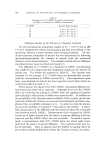
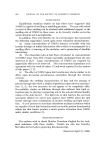
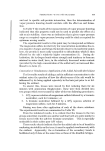
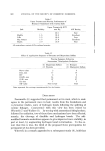
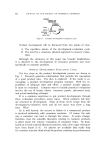
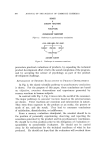
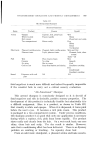
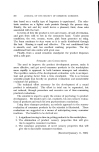
844 JOURNAL OF THE SOCIETY OF COSMETIC CHEMISTS Table II Penetration of C•4-DMSO Through Excised Guinea Pig Skin as a Function of DMSO Concentration % DMSO Absolute Rate Constant 20 3.12 X 10 -4 cm hr -• 40 6.46 X 10 -4 cm hr -• 60 11.9 X 10 -4 cm hr -• 80 357.0 X 10 -4 cm hr -• Diffusion Studies in the Presence of Dimethyl Sulfoxide In vitro percutaneous absorption studies at 30 + 0.05 øC and at pH 7.0 were conducted in which excised guinea pig skin was utilized as the membrane between a donor chamber and a receptor chamber. The rate of percutaneous absorption of picrate ion was determined by following spectrophotometrically the transfer of picrate from the epidermal chamber to the dermal chamber. The complete details of these diffusion experiments have been described previously (1). The diffusion of C14-DMS0 as a function of DMS0 concentration was studied in the guinea pig skin membrane system in the absence of picrate ion. The results are reported in Table II. The absolute rate constant for the passage of C•4-DMSO does not dramatically increase until the concentration of DMS0 exceeds 60%. This dependence upon large concentrations of solvent has been reported several times before in connection with this work (1, 2). }Vhen picrate was dissolved in 80% DMS0, substantial diffusion en- hancement was observed as expected. Attempts to reverse the DMSO effect by removing the picrate in DMS0 from the epidermal chamber and replacing it with picrate in buffer were unsuccessful. In addition to the possibility of the inherent nonreversibility of the system, picrate ion reservoirs within the Stratum corneum and bacteriological problems com- plicated the reversibility attempts (4, 5). In order to avoid the picrate ion reservoir problem, n-butanol-C TM was used as the burden. A three- fold enhancement of the diffusion rate was observed when the n-butanol was dissolved in 80% DMS0. Replacement of the n-butanol in DMSO by picrate in buffer showed that the barrier to picrate diffusion had been removed and the DMS0 effect was not reversible. In another experi- ment, a pretreatment with 80% DMS0 alone for about eight hours destroyed the barrier to picrate diffusion. The controls in this case be- haved normally. Thus, it appears that the DMS0 is causing either an irreversible protein modification within the Stratum corneum, an extrac-
Purchased for the exclusive use of nofirst nolast (unknown)
From: SCC Media Library & Resource Center (library.scconline.org)