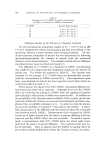
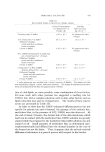
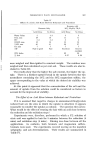
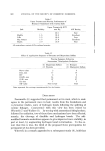
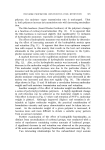
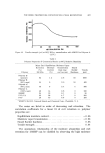
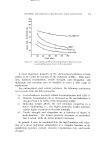
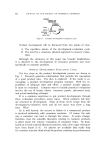
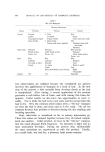
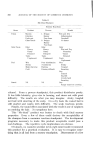
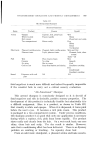
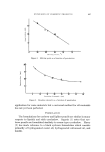
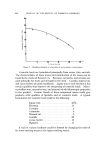
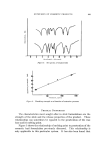
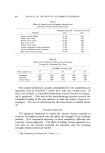
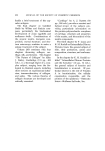
DIMETHYL SULFOXIDE S45 Table III Reversibility Study on Skin From a Single Animal Control-picrate in buffer Test n-butanol-C •4 in buffer Diffusion Chaxnber rinsed and skin membrane frozen overnight Pictate in buffer $0% DMSO pretreatment of epidermal side of membrane for •-•8 hours Diffusion Chamber rinsed and skin membrane frozen overnight Picrate in buffer n-Butanol-C n in 80% DMSO (kinetics followed for •8 hours) Diffusion Chamber rinsed and skin membrane frozen overnight Picrate in buffer Initial Concentration of n-Butanol-C TM or Picrate (M) Absolute Rate Constant kp (cm hr -1) 4.95 X 10⁻² 36.7 X 10⁻² 4.95 X 10⁻² No penetration after 8 hours 24.[½ X 10 t No penetration after 8 hours 4.95 X 10 -• 43.4 X 10 -• 46.0 X 10 -2 8'2.'2 X 10 -i 4.95 X 10 -2 57.2 X 10 -• A male guinea pig was sacrifled with a lethal injection of MgSO4. The abdominal skin was immediately clipped, excised, and frozen until use. The length of time between procure- ment and utilization of the skin was approximately 19 hours. tion of vital lipids, or, more possibly, some combination of these factors. Previous work with other proteins has suggested a swelling role for DMSO, but, with a complex substrate such as skin, other factors such as lipid extraction may also be of importance. The results of these experi- ments are presented in Table III. In order to show that the DMSO-enhanced diffusion process was not specific for picrate ion and n-butanol, the passage of the cationic dye, methylene blue, in the presence of 80% DMSO was also observed. At the end of about 24 hours, the dermal side of the skin membrane which had been in contact with the methylene blue-DMSO solution was grossly stained while that exposed to the methylene blue-buffer solution was not stained at all. Small amounts of methylene blue as determined spec- trophotometrically had diffused into the dermal chamber in the case of the fornter but not the latter. Thus, it appears that the solvent-assisted diffusion of substances is a general process with respect to the burden.

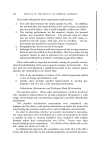
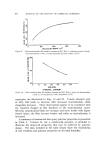
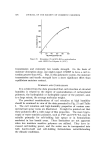
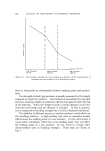
846 JOURNAL OF THE SOCIETY OF COSMETIC CHEMISTS CONCLUSIONS Equilibrium retention studies on hair fibers have suggested that DMSO is capable of swelling or unfolding proteins. The ease with which reversal of fiber swelling can be attained adds additional support to the swelling role of DMSO in these cases, as do viscosity studies on bovine serum albumin and •-lactoglobulin. In addition, Price and Menefee (6), in a recent paper, have presented the following suggestions, based upon stress relaxation measurements: (a) Large concentrations of DMSO interact reversibly with hair keratin through an initial dehydration effect which is accompanied by a swelling effect, a lowering of the modulus, and a promotion of disulfide interchange. (b) The relaxation rates of hair fibers incubated in concentrations of DMSO lower than 80% remain essentially unchanged from the rate observed in H20. Large concentrations of DMSO are required for appreciable effects to be observed. This concentration dependence is in agreement with the work of others (7) and work reported by the authors of this paper (1, 2). (c) The effect of DMSO upon hair keratin may also be similar to its effect upon increasing percutaneous absorption through the Stratum corneum. Although the swdling characteristics of hair and the passage of picrate through skin show a similar dependency upon solvent concentra- tion (1, 2), the two processes do not appear to be completely alike. Reversibility studies on diffusion through skin indicate that lipid ex- tractions may be playing a supporting role in the solvent initiated modifi- cation of the skin barrier. The lipid role in skin barriers has not been accurately defined (8) and it now appears that DMSO alters the skin barrier through some combination of protein swelling and lipid extrac- tion. It is of interest to note that chloroform-methanol solutions which are capable of both lipid extraction and irreversible protein denaturation within the skin barrier produce a much greater alteration than DMSO under similar conditions (9). ACKNOWLEDGMENTS The authors wish to thank Martha Yourshaw English for her tech- nical assistance with these studies. Thanks are also due Dorothy McCullen for her help in preparing this manuscript. (Received April 21, 1968)
Purchased for the exclusive use of nofirst nolast (unknown)
From: SCC Media Library & Resource Center (library.scconline.org)