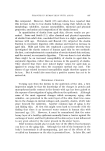
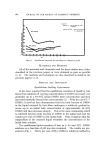
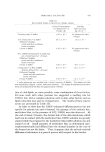
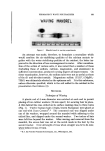
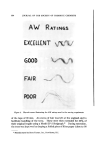
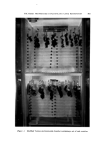
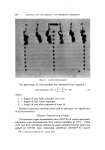
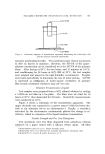
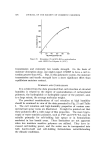
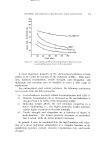
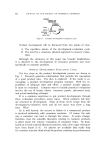
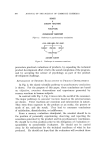
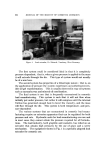
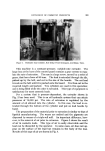
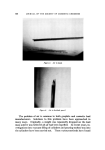
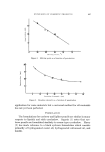
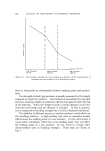
PERMANENT WAVE NEUTRALIZER 851 WAVING MAN'DR[L Figure 1. Mandrel used in waving experiments An attempt was made, therefore, to formulate a neutralizer which would combine the air-stabilizing qualities of the calcium acetate to- gether with the water-stabilizing qualifies of the oxidant, the latter im- proved in the direction of less rearrangement in water. After considera- tion of the action of various salts, it was noted that a number of these (including those of sodium, calcium, magnesium, and aluminum) in sufficient concentration, produced varying degrees of improvement. On closer examination, however, the sodium salts were not as useful as those of the di- and trivalent metals. Magnesium sulfate (U.S.P.) (MgSO4- 7H20) was ultimately selected as the optimum salt. It is this substance, unless otherwise specified, which is the salt added to the oxidant in the presentation that follows (3). METHODS Technique of Waving A plastic rod of 6-ram diameter was notched at each end to permit placing of two rubber washers (19 mm apart) for securing hair in place. A thin helical line was etched on its surface making close to three turns (Fig. 1). Twelve human hairs (virgin, brown European) were glued at one end with Duco Cement ©.* The cemented end was slipped under one of the washers, wrapped around the mandrel while adhering to the etched line, and slipped under the second washer. Two inches of hair were left free beyond the washer. After waving and removal from the mandrel, the excess hair was cut at the notch made in the hair by the second washer. Over-all length of tress when straight was t32 to t34 mm when helical it was 19 mm. * E. I. du Pont de Nemours & Company, Inc., Wilmington, Del.

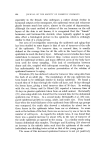
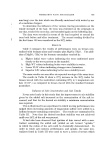
! JOURNAL OF THE SOCIETY OF COSMETIC CHEMISTS 852 The mandrel with attached tress was placed vertically in a test tube 18 X 150 mm and a commercial waving solution containing 7% w/v thioglycolic acid adjusted to pH 9.4 with ammonia was added, sufficient to cover mandrel plus about one inch. After six minutes, the mandrel and attached tress were rinsed five times, with warm (about 50 øC) water. A commercial neutralizing solution containing 9-11% w/v sodium bromate, with and without addition of 30-36% w/v magnesium sulfate (U.S.P.), was then added, and after eight minutes the mandrel and at- tached tress were rinsed three times in warm (about 50 øC) water fol- lowed three times by cold (about 25 øC) water. The mandrel with attached tress was dried by rolling in facial tissue and the tress was removed after about five minutes. PERFORMANCE TESTS Air Stability Air stability tests and measurements were done 5 to 10 minutes after removal from the mandrel in order to allow any relaxation or change in shape of the tress to occur first. Waves were rated by numbers 0, 1, 2, 3: Wave 0--No loop or curl. Wave/--One loop or curl. Wave 2--Two complete loops or curls. Wave 3--(Highest rating)--From 2.5 to just under three loops, and, in addition, of "tight quality"--meaning a diameter close to that of the rod. Distances between Loop Crests (D2L) This measurement is the linear distance in mm from the beginning of the actually waved hair to the completion of the second loop. Best rat- ing: 12 mm, the actual distance on the mandrel. Water Stability After the air stability measurements, the tress was laid horizontally on the surface of a container of water and gently pressed into the water so that it floated freely just below the water's surface. A wave test (WT) rating was then given: Rating 3--Completely water stable, i.e., unaffected by water. May also be tightened by water, as in some cases following unwinding and
Purchased for the exclusive use of nofirst nolast (unknown)
From: SCC Media Library & Resource Center (library.scconline.org)