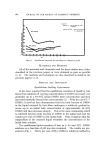
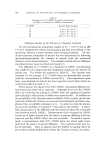
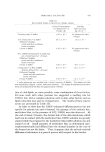
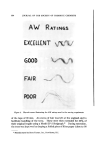
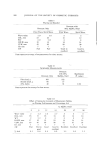
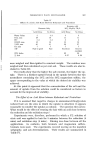
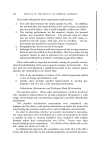
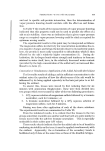
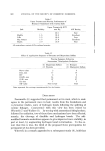
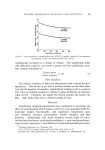
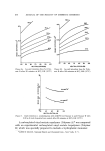
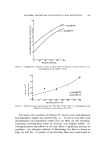
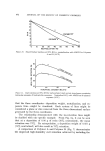
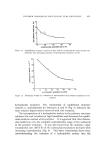
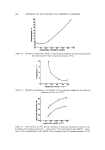
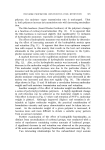
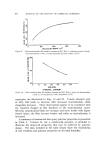
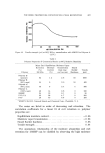
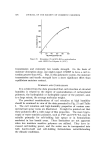
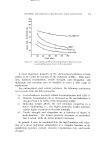
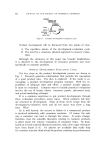
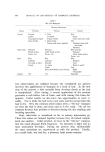
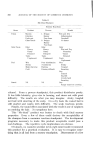
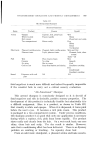
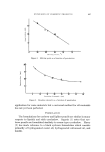
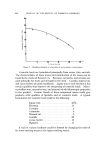
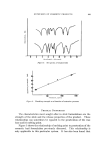
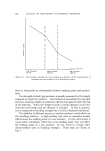
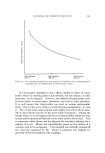
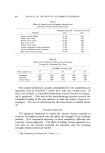
EXTRUSION OF COSMETIC PRODUCTS 903 THIXOTROPIC SYSTEMS At this time there are not sufficient data available to form conclusions on the extrusion of true thixotropic mixtures. These data are being partially obtained by the study of extrusion pressures of various formula- tions. The study of the addition of three waxes to a basic formulation is shown in Table II. The data in Table II were taken on a standard wax base with the ad- dition of 30 wt % of carbon black. The relationship of extrusion pres- sure to breaking strength is shown in Fig. 9. The extrusion pressure should be dependent on the concentrations of the lower and higher melting wax additives. A thixotropic system would not be completely dependent on the individual waxes but more on the ideal concentration of the two materials to give the optimum thixo- tropic effect. A hypothetical curve for this system is shown in Fig. 10. A nonthixotropic system would act as shown in Fig. 11. CONCLUSION The potential for extruded cosmetic products lies in the hands of the formulator. Stick toiletries, such as preshave sticks and deodorant sticks, could easily lend themselves to extrusion. The advantages for extrusion over molding are many. The product would have more strength problems such as air and flaking could be reduced and, finally, the production cost could be reduced by 30 to 50%. Cake mas- cara has been extruded from a standard production formulation with good success. There is also a possibility that pressed powder could be extruded in rectangular form and cut to the required length for godets. Depending on the type of information obtained from these thixotropic studies, lipstick and stick eyeshadow could possibly be extruded. The investigation of wax systems and new raw materials of a wax na- ture can lead to the development of formulations that might better be extruded than molded or pressed. The production cost saving in extru- sion manufacturing warrants further studies by the cosmetic chemist. (Received December 12, 1967) REFERENCES (1) Sagarin, E., Cosmetics: Science and Technology, Interscience Publishers Inc., New York, N.Y., 1957. (2) Harry, R. G., The Principles and Practice of Modern Cosmetics, Chemical Publishing• New York, N. ¾., 1962. (3) Bennett, H., Industrial Waxes, Chemical Publishing, New York, X. Y., 1963, (4) Atlas Chemical Industries, Inc., Bulletin No. LG-GO, Wilmington, Del.

Book Reviews EXTRACELLULAR AND SUPPORTING STROCTOaES (Co•vam•NS•V• B•o- Cim•mTRV), edited by M. Florkin and E. H. Stolz, Vol. 26A and B, American Elsevier Publishing Co., Inc., New York, 1968. 295 pp., illustrated. Price $17. The literature of biochemistry is expanding so rapidly the nonspecialist can be grateful to a series which assembles the most pertinent ma- terial in a given area. "Extracel- lular and Supporting Structures" is the title of Volumes 26A-C of Else- vier series on comprehensive bio- chemistry. Since the appearance in 1962 of the first volumes, every addi- tion to the series has been a valuable contribution to the interrelationships of biochemistry, physiology, and med- icine. With present mainstream efforts in biochemistry devoted to structure and function of intracellular or- ganelles, particularly in mammalian cells, it is important to note the ad- vances made in the area of extra- cellular and supporting structures. Volume 26A contains four chapters. In the first chapter on the Biochem- istry of the Plant Cell Wall by S. M. 905 Siegel, the extraction, separation, and chemical characterization of poly- saccharides, polyuronides, and lig- nins have been treated, followed by present knowledge of the biosynthesis of these components. From a nearly unlimited mass of literature, the author has brought together a 47- page summary with a most useful bibliography by topic. In the second chapter, a cooperative effort between Ghuysen (Liege) and Strominger and Tipper (Madison), a concise but thorough treatment has been ac- corded the structure and biosyn- thesis of the peptidoglycans of bac- terial cell walls, followed by the nature of the protein antigens, poly- saccharides, teichoic acids and lipids of gram-positive bacteria. Chapter III comprises a 107-page thorough treatment, with extensive bibliography, of the somatic and capsular antigens of gram-negative bacteria (Lfideritz, Jann, and Wheat). The principal attention is devoted to the polysaccharide, protein, and lipid components of the somatic O-antigen from various bacteria, followed by characterization of the R-antigens, biosynthesis of 0 and R types, an•
Purchased for the exclusive use of nofirst nolast (unknown)
From: SCC Media Library & Resource Center (library.scconline.org)