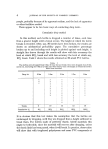
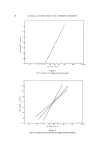
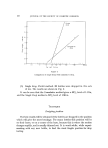
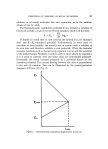
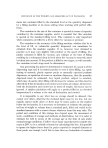
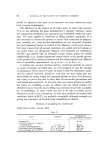
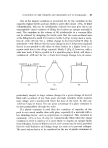
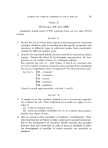
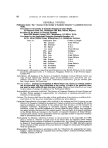
10 JOURNAL OF THE SOCIETY OF COSMETIC CHEMISTS 2.7 2.4 0,9 S•ngle drop 0'1 99'99 •Cumulaf•ve x drop ,, , , , , 2 I0 50 50 70 90 98 Per cent fellure Figure $ Comparison of single drop with cumulative drop. (b) Single drop, Probit method. 50 bottles were dropped in five sets of ten. The results are shown in Fig. 8. It can be seen that the Cumulative method gives a 50% level of 1.17m, and the Single Drop method a 50% level of 1.56 m. TECHNIQUE Dropping position The best results will be obtained if the bottles are dropped in the position which will give the most breakage. For many bottles this position will be on their bases, or on a corner of the base, because this is where the section changes rapidly, and is usually thinned out. It is worth while, while experi- menting with any new bottle, to find the most fragile position for drop testing.

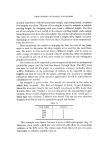
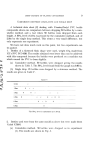
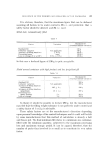
DROP TESTING OF PLASTIC CONTAINERS 11 A variety of methods are used to try to make the bottles fall in a con- sistent manner. In a technique described (2), the bottles are dropped down vertically mounted guide tubes. This method introduces the danger that the bottles will bounce back and forth from the sides of the tubes. Impact testers in which a table falls away from objects placed on it, are very useful. If the bottles are being dropped on to their bases it may be possible to drop several at once. If the bottles are to be dropped in any other attitude, jigs will be necessary to hold them. These must be carefully checked to see that no rotation is imparted to the bottles as the table falls away. Some use a shaped rubber pad connected to a vacuum source. This holds the bottle in the predetermined attitude, and when the vacuum is released, the bottle should fall cleanly. Small bottles can be dropped by hand with reasonable results. If the container is held between two fingers at a point vertically above the centre of gravity it should fall with very little rotation. However, it is difficult to drop them without imparting some slight twist. Dropping surface It is considered important to drop the containers on to a smooth, massive surface. It is suggested that a steel plate at least 6 mm thick, embedded in concrete, is ideal. Plain concrete is not recommended, partly because it is of variable smoothness, and partly because it will wear badly. A steel surface as described will test the containers more rigorously than normal domestic floors. However, it is considered that it is most important that consistent results are obtained, since these can probably be correlated later with practical experience of customer complaints, etc. It might also be considered that a measure of exaggeration in a test is a useful safety factor. RESULTS A few results obtained in developing a PVC bottle for a wave set may be of interest. The bottle has a flattened shape, 90 cm 3 capacity and weigh- ing 13g. Grades PCO 634 and 747 are modified grades of PVC. PCO 638 and VZ 903 are unmodified. It is interesting to note that there is a much bigger difference between the modified and unmodified grades when tested at 10øC, than when tested at normal temperatures. The single figures given in Table VI do not, of course, give any indication
Purchased for the exclusive use of nofirst nolast (unknown)
From: SCC Media Library & Resource Center (library.scconline.org)