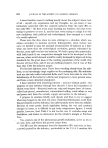
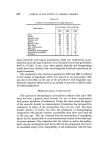
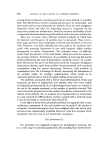
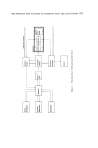
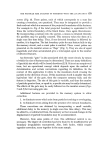
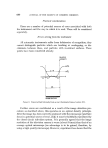
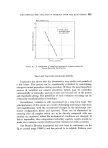
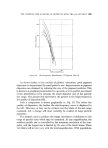
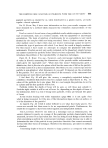
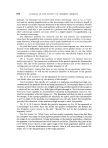
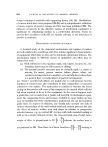
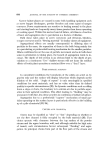
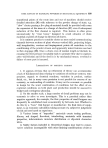
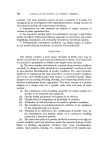
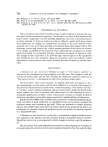
680 JOURNAL OF THE SOCIETY OF COSMETIC CHEMISTS Practical considerations There are a number of potential sources of error associated with both the instrument and the way in which it is used. These will be considered separately. Errors arising from the instrument All automatic instruments suffer from deficiencies of recognition they cannot distinguish particles which are touching or overlapping, or dis- criminate between these, and particles with re-entrant surfaces. These points have been considered already. RELATIVE INTENSITY I I Ii -.--100% •1• 2'7R •-50% I I i i L 3R d I I i I i I I I I • DENSE FEATURE Figure 9. Expectedlight intensity from a rear illuminated dense feature (10). Further errors are contributed as a result of the image detection pro- cedure as described above, this operates on an optical density principle. After the image has been correctly produced with the microscope [and here focus is a potential source of error, (12)• it must be faithfully reproduced by the closed circuit television system. It is generally agreed that the image resolution of the television camera is worse (about 5 times) than that of an average optical microscope (no advantage is to be gained, therefore, by using a high quality microscope). However, experiment has shown that the

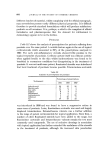
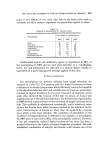
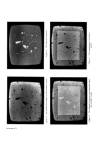
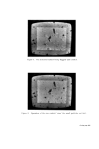
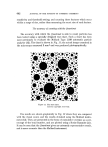
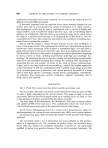
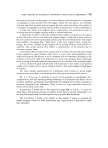
Figure 7. The detected features being 'flagged' and counted. Figu. re 8. Operation of the size control, 'sizes' the small particles out first. Facing page 680
Purchased for the exclusive use of nofirst nolast (unknown)
From: SCC Media Library & Resource Center (library.scconline.org)