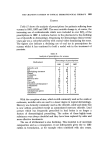
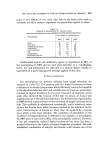
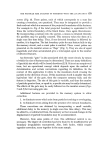
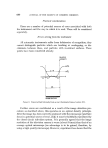
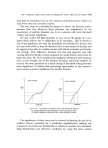
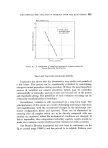
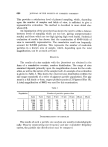
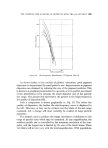
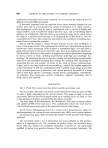
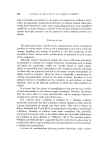
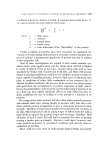
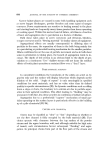
THE PARTICLE SIZE ANALYSIS OF PIGMENTS WITH THE QU•dNTIMET 681 final limit of resolution is set by the computer detection circuit, which is in turn worse than the television camera. The next stage in evaluating the image is to detect the features, and to measure their size. However, these processes are complicated by the uncertainty of particle diameter due to its variation with both threshold setting and image brightness. We may expect the light intensity to vary across the image of a per- fectly black feature due to diffraction at its boundary. This is shown in Fig. 9 and implicates not only the possibility of resolving the feature, but the ease with which it may be detected (due to unevenness of density) and its apparent size (due to variation in size with detected density and thresh- old setting). This difference between true size and apparent size with varying detected density is more apparent for small feature areas than for large ones (Fig. 10). If we consider any population of features with constant area, as the average size of the features decreases (and, their number in- creases) the errors produced by a small change in threshold setting becomes more significant. It follows that percentage inaccuracies in size measure- ment assume a greater significance for smaller features. LARGE FEATURES / AREA % I i I ,,, THRESHOLD AREA % SMALL FEATURES / I _ I THRESHOLD Figure 10. Variations in feature area with detected density. (a) Large changes in threshold give small changes in area. (b) Small changes in threshold give large changes in area. T he significance of these errors can be reduced by limiting the size of the smallest feature examined for a particular magnification making any evaluation of particle size distribution in relation to another one standard- ising illumination and detection conditions by using the same camera

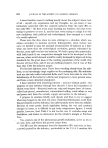
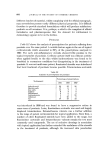
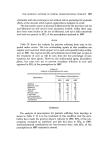
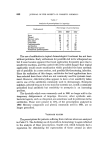
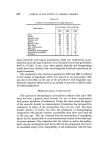
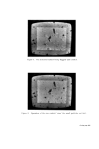
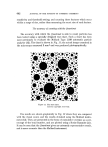
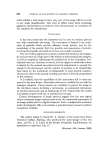
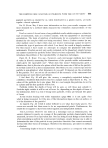
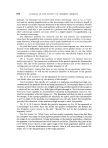
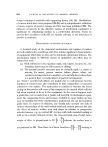
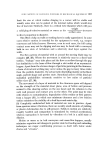
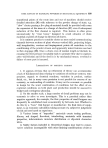
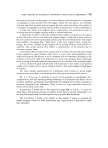
682 JOURNAL OF THE SOCIETY OF COSMETIC CHEMISTS sensitivity and threshold setting and counting those features which occur within a range of size, rather than measuring the exact size of each feature. The accuracy of counting with the Quantimet The accuracy with which the Quantimet is able to count particles has been tested using a specially designed test chart. Such a chart has been used previously to evaluate the Mullard Type L188 automatic particle analyser (12). The chart is shown in Fig. 11 the actual image examined in the microscope measured 2 mm2 and was produced photographically. o.e ß ß .0.1 Figure 11. The test chart. (Crown copyright reserved). The results are shown graphically in Fig. 18 where they are compared with the visual count, and the results obtained using the Mullard instru- ment (12). They are presented in the form of cumulative oversize as a per- centage of the total number, and are plotted using a Rosin-Rammler axis. It can be seen that the Quantimet gives an extremely representative result, and is more accurate than the Mullard instrument.
Purchased for the exclusive use of nofirst nolast (unknown)
From: SCC Media Library & Resource Center (library.scconline.org)