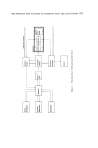
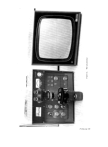
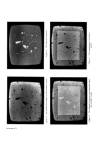
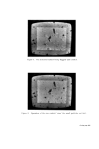
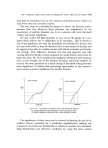
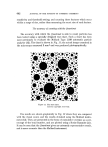
THE PARTICLE SIZE ANALYSIS OF PIGMENTS WITH THE QUANTIMET {591 pigment particles as studied by us, when distributed in a plastic matrix, are fairly regular--almost spherical. Dry. R. PucK: May I have some information on how your results compare with those obtained by a method which measures the volumetric characteristics of the particle? T}•E LECTURER: I do not know of any published results which compare a volumetric type of instrument, such as a Coulter counter, with the Quantimet or microscopic examination. The basis of selection of instruments for an evaluation is very much dictated by the samples which are being examined. Since a Coulter counter (or any other method come to that) which does not involve microscopy cannot be used to evaluate the type of specimen with which I am faced, the result is largely academic. For this reason I have made no attempts to compare the Quantliner •vith other instruments. Powders are not very easily evaluated on the Quantimet, simply because one cannot examine the particles before they have been separated. This imrnediately introduces the problem of the reproducibility of dispersion techniques. PROF. H. E. ROSE: You say--"however, such microscopic methods have been of value in directly measuring the dimensions of the particle unlike sedimentation which gives the equivalent size". What does this mean? Sedimentation gives a definite size, that is the size of a sphere which has the same rate of fall as the particle. So to that extent i•is a direct measurement. But when you use a microscope and the particle is non-spherical, what dimension do you get? It depends on the orientation of the particle. So I am not at all convinced of the accuracy of the statement that microscopes are more direct and definite. I feel that Fig. 1• will give the unwary a completely unjustified feeling of confidence. Doubtless this result is true for a sample such as that shown in Fig. 11, where all the particles lie in one plane. But in a real sample the particles do not lie in a plane and the fine particles will be lost. Particles within the depth of focus will be seen, so will those just outside it. Particles right outside it will be out of focus. So, depending on the depth of focus of the instrument, there is a risk of losing some particles, if they are beyond the plane of focus. In the section dealing with solids suspension (page 685) it is not quite clear what is being measured. Is it the size of the intersection figure on the cut surface or is it the diameter of the particle? As regards Fig. 13, I find it rather difficult to see what that really proves. The curves are smooth but there seem to be no experimental points. Furthermore, the results do not appear to have been tested against any independent method. TEE L•c•um•: Hoxvever one looks at a technique such as sedimentation, the answer obtained is purely an average of the particular particle characteristic being measured, in terms of an equivalent size. One can bring in such things as form factors when examining a particle by a microscopic tenchique, simply because one is able to determine the size of the particle in any particular direction. One cannot necessarily do this with other forms of technique. Therefore the dimension, provided it is defined, is absolute. Concerning depth of focus in relation to large particles as coinpared with small

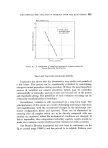
692 JOURNAL OF THE SOCIETY OF COSMETIC CHEMISTS particles, our technique has involved thin section microscopy, and so far we have not used an optical magnification on the microscope which has involved a depth of focus which was smaller than the thickness of the section which we examined. For this reason it is unlikely that the small particles will be lost. If the small particles cannot be resolved, (and this is just as much of a problem with the Quantimet as with any other microscopic system) one must resort to a higher degree of magnification, e.g. the electron microscope. The difference between the observed and the real particle size distributions arises from the possibility that a random section may not cross a particle at its maxi- mum diameter. Although corrections can be made statistically so as to overcome this problem, we have not attmnpted such a transformation as yet. On your final point--these results have not been tested against any other method because of the difficulties presented by the presence of the plastic matrix. It was the very presence of this matrix, which prevents us from being able to use the better established techniques. However, I see no reason why this should detract from the general usefulness of the Quantimet. DR. J. GLAsB¾: Surely the question of which diameter you measure does not really come into it. The camera sees a silhouette of the particle against the illumination source. The size of the particles therefore is the projected area in the direction of viewing and you will not see the smaller diameter at all. THE LECTURER: I agree that since we are viewing all our specimens under trans- mirtent conditions, we will see the maximum diameter of that part of the particle which is in the section. DR. N. A. R. LEROUX: Can the Quantimet be used to examine emulsions and can you clarify what you mean by the opacity of the sample? TaE L•CTUR•R: The opacity of a sample is a limitation resulting from high con- centrations of the particles which are being examined. If, for example, there is a lot of titanium present there will be a lot of light scattering, and the opacity of the sample as a whole will be very high. Very little light will pass through it. The television camera does have some capacity to accommodate variations in illumination. but it is very small in comparison with the human eye. The Quantliner will thus be able to evaluate the sample, if the opaque particles are relatively far apart, and if the concentration is not too high. If the particles are transparent you will only detect the boundaries, provided the refraction of the medium is high enough to show the particle. DR. N. A. R. LEROUX: Should the particle frequency in Fig. 18 be expressed as a percentage? You state, that "the better the quality of dispersion, the further the size frequency curve moves to the left." Should this not be the cumulative size frequency curve? T•E LECTURER: No. What I may not have made completely clear is the fact that the complete size range of those pigment particles which we are examining is beyond the range of our examination. A large percentage of the particle population, whatever the pigment, is in fact beyond the lower limits of resolution. Therefore that part of the curve which I have drawn, is the upper range of the total population plotted as size frequency. If the size distribution does improve, then it will move back towards the origin, due to the disappearance of the larger particles.
Purchased for the exclusive use of nofirst nolast (unknown)
From: SCC Media Library & Resource Center (library.scconline.org)