J. Soc. Cosmetic Che•nists 20 693-703 (1969) ¸ 1969 Society of Cosmetic Chemists of Great Britait, Some aspects of handling powders in mechanical equipment L. BATES* Presented at the sym,posium on "Powders", organised by the Pharmaceutical Society of Ireland and the Society of Cos•nelic Chemists of Great Britain, at Dublin, on 17th April 1969. $ynopq•--The paper outlines the concept of controlled powder state throughout its complete route in the factory with particular reference to mechanical bulk handling techniques. INTRODUCTION Mechanical equipment for handling particulate solids falls into two broad categories. Either they are moved via a supporting surface or con- tainer, e.g. belt conveyor, bucket elevators, or are promoted to motion by the influence of one or more pressure faces and the effect of gravity. A summary of the various types of machines is given in British stan- dards (1). In the former cases, the effect of material characteristics are mainly related to feed and discharge conditions. Features such as dust, abrasion contamination, etc., are generally predictable from an understanding of the specific characteristics of the material being conveyed. Attendant feed hoppers and chutes are subject to independent design considerations taking account of possible vibration, air flow, condensation, or other extraneous interference from the local conditions. En masse conveyors, on the other hand, achieve a condition in the powder due to the influence of relative motion in the mass, slip on walls and blades, and free surface activity in- fluenced by gravity. The behaviour of a powder is determined by this state which it attains as the relative freedom of interparticulate motion of the *Fairxvay Engineering Co. Ltd., •rorsley, nr. Manchester. 693

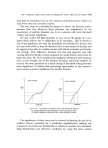
694 JOURNAL OF TttE SOCIETY OF COSMETIC CHEMISTS bulk is basically determined by the degree of compaction or dilation of the solids. An important consideration therefore, is whether motion takes place within fixed boundaries under some compacting pressures or in unconfined conditions as shear strength is related to the stresses normal to the failure surface and high pressures can be generated under confined powder con- ditions. POXVDER STATE The pioneering work of Jenike (2, 3), stimulated the study of industrial powders in various states of stress and a framework is now set to relate the storage, handling and mixing of powders to the flow properties of the material in these various states, and the mode of operation of each section of the equipment. Although various rheological models have been built froIn elementary mechanisms to examine the complex behaviour of materials such as dough and paint (4), particulate solids are usually found in rigid plastic, elastic or quasi-fluid states depending on the conditions of stress and strain to which they are subjected and due to the many variable of materials, no simple model is adequate. However, flow is essentially a mechanism in- volving interparticulate motion in the form of shear, therefore, it is of primary interest to establish how the resistance to such motion, i.e. shear strength, varies in the differing conditions to which the bulk materials are subject. It is found that the degree of consolidation of the powder has a funda- mental relationship to the shear strength developed. Hvorslev (5) showed that the shear stress to cause material flow can be uniquely related to normal stress and the voids ratio of the mass. The "critical state" condition is attained by a yielding, confined, particulate material when flow continues without change in voids ratio for a given relationship of normal and shear stress. This state is shown by Rosco, Schofield and Wroth (6) to be independent of starting or transitional conditions. Shearing of surfaces from static conditions will. generally, cause local increase in voids on the failure plane due to particle interference (7) resulting in some dilation or "dilitancy" (8) in the shearing regions. Williams and Birks (9) have suggested that the work done in shear may be considered in the two parts of that lost in internal friction and that necessary to displace the normal load. A review of considerations affecting powder behaviour under various
Purchased for the exclusive use of nofirst nolast (unknown)
From: SCC Media Library & Resource Center (library.scconline.org)